Browse Our Stories
Mon, Nov 30 2015
Lower Novato Creek Vision Just Released!
SFEI recently released a resilient landscape vision for lower Novato Creek that incorporates habitat restoration actions into flood risk management.
Wed, Nov 18 2015
SFEI representatives Cristina Grosso and Josh Collins helped to foster the use of EcoAtlas and related tools in the Lahontan region during a recent workshop, which is part of a broader project. The objective of the workshop was to train interested parties inside and outside of the Tahoe Basin on EcoAtlas’ watershed-based decision support tools. The workshop began with a presentation on the applications of watershed-based decision support tools in the regulatory context. A Technical Demo Session and Open Lab provided hands-on training for EcoAtlas’ planning (CARI/TARI, CARI Editor), tracking (Project Tracker), and visualization tools (Landscape Profile Tool).

Tue, Nov 17 2015
In a story called "Synthetic Clothes May Be Polluting San Francisco Bay," KGO-TV's Dan Ashley interviews SFEI's Rebecca Sutton, UC Davis professor Susan Williams, and Jim Erin from the San Jose-Santa Clara Regional Wastewater Treatment Facility about the proliferation of synthetic fibers in the Bay. Such fibers may come from fleece jackets and other clothing produced from artifical fabrics.
Wed, Oct 21 - Thu, Oct 22 2015
KQED Forum: Bay Area Infrastructure, Communities at Risk Without Wetlands Restoration
On KQED Forum, Michael Krasny interviewed SFEI's Letitia Grenier and the State Coastal Conservancy's Sam Schuchat about the release of the new Science Update Report and its findings regarding the urgency to restore wetlands in advance of accelerating sea-level rise. As offered on KQED's website, "the new report reveals that 42,000 acres of wetlands in the Bay Area must be restored over the next 15 years to mitigate the effects of climate change. Rising sea levels, swelling tides and strong storms threaten billions of dollars worth of businesses, homes and infrastructure." The Baylands and Climate Change: What We Can Do, from over 100 scientists and 17 governmental agencies, urges action to restore wetlands as a key component to protect cities and critical infrastructure from imminent threats.
Mon, Oct 19 - Fri, Oct 30 2015
Baylands Goals Report Released to a Flurry of Media Attention
An update to the 1999 Bayland Ecosystem Habitat Goals, the new report called The Baylands and Climate Change: What We Can Do urges swift action to restore our wetlands as a buffer against rising seas and associated flooding. Sea-level rise will increase in a few decades. If we do not act swiftly to restore our Bay Area wetlands, our cities will be in greater peril for increased flooding and infrastructure impairment. Our highways, airports, utility services, pipelines, water treatment plants are all threatened by rising tides.
The report synthesizes the recommendations of 200 scientists and government experts on climate change, sea level rise, watershed systems and urban engineering.
Thu, Oct 15 2015
Polybrominated diphenyl ethers (PBDEs), widely used as flame retardants, were previously poorly characterized, but significant information on their distributions and impacts have been collected in recent decades.
Fri, Oct 9 2015
Plastic microbeads are in the news, and SFEI is providing the science
In the wake of the passage of the microbead ban, KQED released a story about its potential hazards. As a science resource, Dr.
Fri, Oct 9 - Fri, Oct 30 2015
Our Bay on the Brink: SFEI's Jeremy Lowe explains the urgency for sea-level-rise adaptation
SFEI's senior scientist Jeremy Lowe has appeared in a video with the Coastal Conservancy's Amy Hutzel, the South Bay Salt Pond Project's John Bourgeois, the Bay Area Economic Council's Sean Randolph, Save the Bay's Allison Chan, and Match.com's Gary Kremen, to provide background in sea level
Fri, Oct 9 - Fri, Oct 16 2015
SFEI science informs state policy on microplastic pollution
Last week, the Governor signed AB 888, a bill that bans microplastic beads in personal care products. Companies have until 2020 to phase out the use of these "microbeads." California now has strongest state law in the nation on this issue.
SFEI science played a key role in informing policymakers about microbeads and microplastic pollution. Media stories on a Regional Monitoring Program study of microplastics in San Francisco Bay water and treated wastewater broadcast the latest findings to a wide audience. The study indicated that our Bay had higher levels of microplastic pollution than the Great Lakes and Chesapeake Bay. Clearly identifiable microbeads derived from personal care products were detected at all nine sites examined in San Francisco Bay.
Fri, Oct 2 2015
USGS StreamStats API available in EcoAtlas
StreamStats is a web service provided by the US Geological Survey and used to delineate an upstream catchment from a user-defined pour point.
Thu, Oct 1 2015
New Project Tracker online forms
New Project Tracker online forms enhance EcoAtlas' regional capacity for habitat restoration project tracking, assessment and reporting. Partners can now upload and edit project information and approve projects for display on EcoAtlas.
Tue, Sep 29 2015
New Trends Charts and Data on Safe To Eat Portal
Fish and shellfish are nutritious and good for you to eat. But some fish and shellfish may absorb toxic chemicals from the food they eat and the water in which they live.
Wed, Sep 23 2015
KPIX and KNTV Television interview Rebecca Sutton about microplastic contamination in the Bay
With separate news crews, KPIX and KNTV followed up on the San Jose Mercury and Contra Costa Times stories by Paul Rogers regarding the surprising findings revealed by a new study. Led by SFEI's Rebecca Sutton, the study on microplastics uncovers the widespread extent and high level of microplastic contamination in the S.F. Bay. Microbeads -- the small synthetic granules found in cosmetics, soaps, and even toothpaste -- form the primary focus of the study. The study's early results have prompted concern from the public regarding the potential impacts to human health and the cumulative impacts to our S.F. Bay ecosystem.
Mon, Sep 21 2015
SFEI featured in 5 major newspaper articles over two weeks
Articles featuring the Pulse of the Bay, the State of the Estuary Report, and SFEI's work on microplastics saturate the news media since Sept 9, 2015.
Recent weeks have demonstrated the tremendous value that SFEI brings not only to the domain of environmental science but also to resource management and the public landscape. The deluge of articles covers a wide breadth of subjects, each with great urgency and relevance to issues of public importance.
Mon, Sep 21 2015
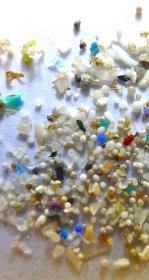
Microplastics study led by Rebecca Sutton is featured in a news story
Rebecca Sutton, senior scientist at SFEI, describes the hazards presented by microplastics in the Bay's waters. "Plastic pollution: Billions of pieces of tiny plastic litter found in San Francisco Bay," a news article by Paul Rogers reports on findings in a recently published study for which Rebecca Sutton serves as lead author. What the researchers discovered, the high degree of plastic contamination, surprised them.
Sat, Sep 19 2015
Journalist Mark Prado's article in the Marin Independent Journal reports the mixed picture of health in the San Francisco Estuary. He writes:
“In many regards the bay is as healthy as it has been in a long time,” said San Anselmo native Josh Collins, chief scientist with the San Francisco Estuary Institute. “But some aspects of the bay are slower to heal,” he added. “There are sill longer-lasting pollutants in the bay, but they are not being put in the system anymore.”
Thu, Sep 17 2015
Rising seas threaten San Francisco Bay and Delta wetlands and land
Dennis Cuff of the San Jose Mercury News wrote an article on the relationship between the region's wetlands and sea level rise.
Tue, Sep 15 2015
San Francisco Chronicle writer John King wrote a part-story / part-commentary that challenges local leaders to address sea-level-rise issues. The article highlights SFEI's concept of the need for a 100-year vision for the SF Bay region and Estuary.
Wed, Sep 9 2015
The SF Chronicle features the release of the Pulse of the Bay
On September 9, the San Francisco Chronicle highlighted some of the environmental strides and challenges revealed in the latest Pulse of the
Sun, Aug 30 2015
RL journal publication on using historical ecology research to inform river restoration
SFEI scientists in the resilient landscapes program, in collaboration with Pete Downs of Plymouth University and Brice Orr of Stillwater Sciences, published an article on how historical ecology can infrom river restoration on the Santa Clara River.
Wed, Aug 26 2015
2014 RMP Sediment and Bivalve Data Now Available on CD3!
In 2014, the Regional Monitoring Program for Water Quality in San Francisco Bay (RMP) collected sediment and bivalve samples from San Francisco Bay as part of its long-term monitoring program.
Thu, Aug 20 2015
EcoAtlas: New Map Enhancements
The latest release of EcoAtlas (v4.1) includes two new map enhancements:
Mon, Jul 13 2015
"As climate change puts ecosystems and species at risk, conservationists are turning to a new approach: preserving those landscapes that are most likely to endure as the world warms."
Mon, Jul 6 2015
EcoAtlas: New CARI Editor and Modern Delta Habitat Types
An accurate basemap is fundamental to watershed planning and assessments. The California Aquatic Resources Inventory, or CARI, offers such a basemap for aquatic resource identification and classification. But to keep it current and enhance its details, SFEI-ASC must leverage local knowledge. The new CARI Editor promotes regional stewardship and allows users to submit updates, deletions or new features for streams and wetlands.
Tue, Jun 30 2015
Version 2 of the BAARI (Bay Area Aquatic Resource Inventory) GIS dataset has been released. Local experts provided advice on and reviewed BAARI’s baylands, stream and wetland data layers to increase its accuracy and detail.
Mon, Jun 22 2015
National science experts gather to discuss Flood Control 2.0
A panel of nationally and internationally renowned scientists gathered in the Bay Area at the beginning of June 2015 to provide feedback on the EPA-funded Flood Control 2.0 project.
Fri, Jun 19 - Mon, Jun 22 2015
Web Services Available for CRAM and Wetland Projects
Web services provide a standard way to access geo-referenced data online.
Wed, Jun 17 2015
New Developments in Emerging Contaminants and Green Chemistry
SFEI tracks contaminants of emerging concern (CECs), building the knowledge necessary to prevent tomorrow’s pollution problems. SFEI also aids pollution prevention efforts through our Green Chemistry focus area.
Tue, Jun 16 - Mon, Jun 22 2015
Carlos Street Rain Garden Interpretative Sign
An informative and beautifully designed interpretative sign educates the public on the effects of stormwater runoff, the impacts on water quality and aquatic life, the beneficial uses of "rain gardens" or natural stormwater treatment areas, and the role individuals can play in cleaning-up our wat
Mon, Jun 15 - Mon, Jun 22 2015
SFEI leads technical workshop in support of BCDC's Policies for a Rising Bay project
In May 2015, SFEI staff organized and led a workshop of regional experts in support of BCDC's Policies for a Rising Bay project which is investigating potential changes to their Bay Fill policy in light of sea level rise.