Understanding a Changing System
The Nutrient Management Strategy (NMS) plays a critical role in monitoring San Francisco Bay and the Sacramento-San Joaquin Delta’s complex response to nutrient inputs. Continuous and comprehensive monitoring programs are vital to measure nutrient levels, sediment concentrations, light availability, freshwater inputs, and ocean conditions. These variables are shaped by natural and human-based nutrient inputs, local management actions, and climate fluctuations. Regular monitoring is essential to understand water quality and ecosystem shifts resulting from high nutrient inputs.
Since 1969, the US Geological Survey (USGS) has monitored the Bay's water quality, creating one of the world's longest-running estuarine monitoring programs. This invaluable dataset has unveiled significant shifts in the Bay's response to rising nutrient levels in recent years.
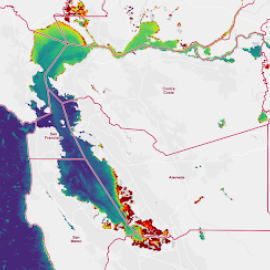
Since the inception of the NMS, nutrient-related monitoring in the Bay has expanded with more cruises, more sampling stations, and more data collected. Collaborative efforts with partners like the USGS and UC Santa Cruz involve regular water quality sampling cruises along the Bay's deep channel and across the shoals, providing critical data on nutrients, phytoplankton types, and harmful algal toxins.


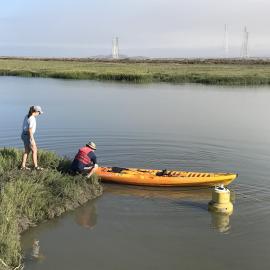
In 2014, the NMS launched the Moored Sensor Program to intensify data collection and learn more about the Bay’s chemistry, biology, and physics. This program manages water quality sensors at 15 stations across the Bay, offering real-time data on parameters like dissolved oxygen and chlorophyll-a every 15 minutes. These sensors complement the USGS deep-channel and shoal-mapping cruises to extend monitoring to crucial areas other long-term efforts miss.
In partnership with the USGS, SFEI’s expanded monitoring has informed research and advanced modeling of nutrient management needs. Our efforts revealed recurring issues like low oxygen levels in shallow habitats along the Bay and harmful algal toxins, both of which are health concerns for humans and ecosystems.
In addition to the Moored Sensor Program, the NMS works on other innovative monitoring approaches:
- DNA-based techniques detect harmful algae.
- Ongoing tracking of algal toxins in native mussels along the Bay's shoreline indicates algal toxins entering the local food web.
Our comprehensive monitoring approach enhances how much area we cover. It also provides valuable insights into the always-changing processes affecting water quality in the region.

Latest News

Tue, Nov 19 2024
Nature-based solutions for wastewater treatment
Featured Projects

Recent Publications

Remote Sensing Recommendations for Tidal Wetland Indicators
This document presents potential products and methods for monitoring a suite of tidal wetland habitat indicators designated for the Montezuma Wetlands Project using remote sensing technology. This document can also serve…
ASSOCIATED STAFF