Summary
- "Forever chemicals" (PFAS) can cause serious health issues. They are in San Francisco Bay at concerning levels for people and possibly wildlife.
- Many forever chemicals wash into the Bay from everyday products used both inside households and outdoors. They enter the Bay in wastewater and stormwater.
- SFEI scientists are leading studies to better understand how forever chemicals reach the Bay. Partnering with managers and policymakers will help them build effective policy to stop pollution at the source.

Toxic forever chemicals, or PFAS, are in households, landscapes, and waterways, where they can harm people and ecosystems. PFAS Sources to Solutions is a multi-year collaboration to monitor forever chemicals in San Francisco Bay, identify how they get there, and report findings to lead to meaningful solutions.
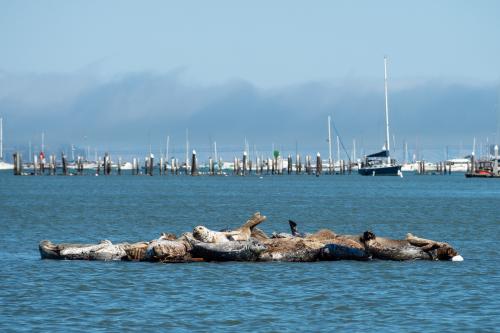
In 2024, SFEI scientists with the Regional Monitoring Program for Water Quality in San Francisco Bay (RMP) reported forever chemicals as one of the most concerning kinds of pollution in the Bay. Two decades of world-class PFAS monitoring discovered pollution throughout the Bay, including in fish people eat.
We also found forever chemicals flowing to the Bay in two major pathways: urban stormwater runoff and municipal wastewater effluent (treated sewage). One collaboration with the Bay Area Clean Water Agencies revealed that consumer products in homes may account for a large majority of the PFAS entering wastewater facilities. In another study, we found forever chemicals in stormwater runoff from every site tested across dozens of Bay Area cities and suburbs. These results suggested that common outdoor products may contribute PFAS to stormwater.
Sources to Solutions uses innovative techniques to understand how forever chemicals reach the stormwater and wastewater pathways and where they come from. With this information, decision makers can ban forever chemicals from priority products to prevent PFAS pollution before it reaches the Bay. Emphasizing source products recognizes that stopping pollution at its origins works better than trying to clean it up afterwards.
This work is active and ongoing, with final results expected by 2029. To learn more or collaborate, please contact [email protected].
Conceptual Models Spotlight Sources

By the time water flows into a Bay Area wastewater treatment plant or storm drain, it has collected hundreds of types of PFAS from household and outdoor products. But although we know lots of consumer products can contain forever chemicals—like clothes and textiles, cleaning products, cookware, cosmetics, paints, packaging, construction materials, and more—nobody has identified which send the most pollution to the Bay.
Our team is examining research from across the world to fill this gap. We also diagram the complex routes these chemicals take to reach urban stormwater runoff and municipal wastewater, from rainfall washing over buildings to running loads of laundry with PFAS-treated clothes. Sources to Solutions is among the first efforts in the world to develop a detailed understanding connecting PFAS from outdoor source products to stormwater. We'll use what we learn to fill important data gaps about forever chemicals in various products and which might release the most pollution.
Product Testing

California has banned forever chemicals from several household products, from carpets to cosmetics. More products will phase them out in the next few years. However, because items like sofas or rugs are meant to be used for years, they keep contributing forever chemicals to the environment long after stores stop stocking them—and once they’re in the Bay, the PFAS don’t break down.
Testing how much PFAS is in various products will help regulators prevent pollution at the source. The California Department of Toxic Substances Control, a project partner, will incorporate results into their Safer Consumer Products Program to prioritize regulating forever chemicals from products that contribute the most pollution to the environment.
From Sources to the Bay
Although San Francisco Bay leads the world in monitoring forever chemicals in both stormwater and wastewater, important questions remain about how much PFAS enters the Bay and how much comes from each pathway.
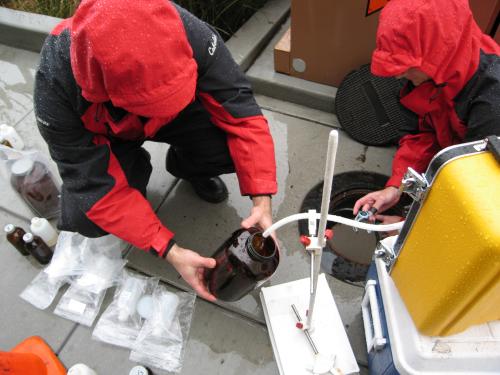
Global research linking outdoor products to PFAS pollution in stormwater runoff is scarce. We’re building on our groundbreaking stormwater runoff study to trace PFAS that enters San Francisco Bay when it rains back to the source products. Sources to Solutions is filling in gaps identified from this monitoring and expanding PFAS sampling during the rainy season. By sampling creeks and urban tributaries across the Bay, our scientists can identify which have the most PFAS and compare the land uses and outdoor products that the high-pollution areas have in common.
We’re also building on our innovative investigations of forever chemicals in municipal wastewater. Samples from wastewater monitoring in the San Francisco Bay region showed declines in the concentrations of a few well-studied and regulated forever chemicals. However, we also found high levels of replacement chemicals. Additional wastewater studies in collaboration with Sources to Solutions will help estimate how much total PFAS enters the Bay through this pathway.
This project has been funded wholly or in part by the United States Environmental Protection Agency under assistance agreement #98T95901 to San Francisco Estuary Institute. The contents of this document do not necessarily reflect the views and policies of the Environmental Protection Agency, nor does the Environmental Protection Agency endorse trade names or recommend the use of commercial products mentioned in this document, as well as any images, video, text, or other content created by generative artificial intelligence tools, nor does any such content necessarily reflect the views and policies of the Environmental Protection Agency.












Forever chemicals in household products contribute to Bay pollution
SFEI partnered with Bay Area Clean Water Agencies (BACWA) to implement a collaborative, cost-effective, and innovative investigation of PFAS in municipal wastewater in the San Francisco Bay region.

PFAS in San Francisco Bay Water
Scientists with the San Francisco Bay Regional Monitoring Program (RMP) detected PFAS, also known as “forever chemicals,” at parts per trillion concentrations in the waters of the Bay.

Perfluoroalkyl and polyfluoroalkyl substances (PFASs) are a broad class of fluorine-rich specialty chemicals. More than 4,700 PFASs are used in consumer, commercial and industrial applications.