The Building Block of the Bay
Sediment like sand, silt, and mud is critical to the health of the San Francisco Bay ecosystem. It is the physical foundation for tidal marshes, which must grow vertically to keep pace with sea level rise and continue functioning as natural filters for nutrients and pollutants from urban, agricultural, and industrial runoff. Sediment on the Bay floor can store contaminants within water trapped between the mud or sand particles, and suspended sediment can transport contaminants throughout the Bay.
Sediment is dredged from Bay shipping channels, harbors, and ports. Some dredgers remove sediment from the Bay completely, which helps remove contaminants from the system, and some is reused in wetland restoration projects. In addition, suspended sediment is a key factor limiting algal blooms. Researchers and decision makers are focusing more on sediment processes in the Bay, driven by the need for better information on water and sediment quality, as well as the impacts of climate change and sea level rise on the Bay’s tidal wetlands.
Advancing Sediment Management
In 2018, the RMP formed the Sediment Workgroup to provide technical oversight and stakeholder guidance on RMP studies addressing management and policy needs related to sediment delivery, sediment transport, dredging, and beneficial reuse of sediment within the Bay. The Sediment Workgroup includes representatives from federal and state agencies, including the US Environmental Protection Agency, US Army Corps of Engineers, US Geological Survey, San Francisco Bay Regional Water Quality Control Board, and San Francisco Bay Conservation and Development Commission, as well as representatives from ports, the dredging community, local water agencies, universities, and private consulting firms.

Spotlight on Recent Work
Fine Sediment Transport
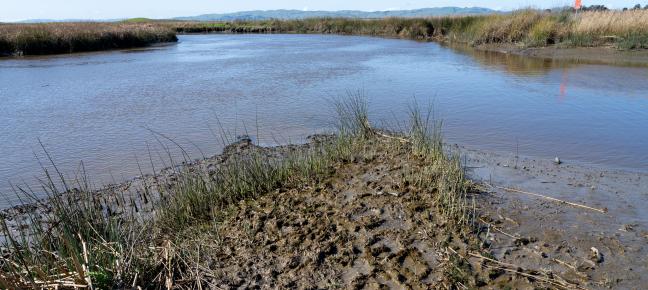
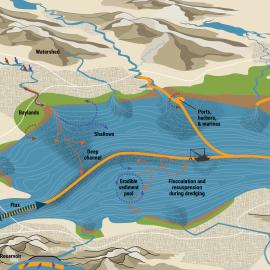
Tracking how sediment moves around the Bay is essential to understand how harmful contaminants move as well. It also helps predict how critical San Francisco Bay habitats will evolve under a rising sea level. Our Conceptual Understanding of Fine Sediment Transport in San Francisco Bay report provides detailed conceptual models of sediment movement around the Bay, both now and into the future under a changing climate. The report also identifies key data gaps that must be addressed to improve our understanding.
Bay Floor Bathymetry
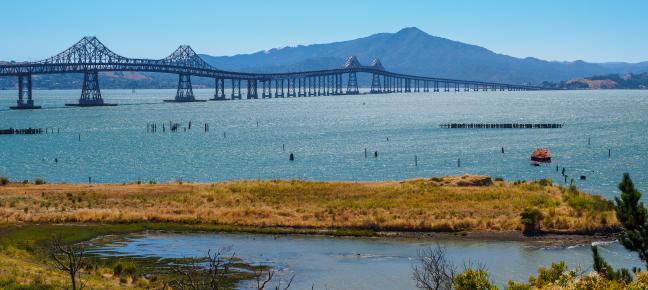
The amount and location of sediment deposition and erosion on the Bay floor helps inform habitat restoration and management strategies. The RMP recently funded the USGS to determine Bay floor elevation change over the past several decades. The findings in the resulting USGS Open File Report show that the Bay floor is eroding overall, but that some local areas throughout the Bay consistently accumulate sediment.
Science Advisors
The scientific advisory panel for the Bay RMP Sediment Workgroup consists of two internationally renowned estuarine sediment experts:

SFEI Lead Scientist

For more information, please contact Scott Dusterhoff at [email protected].
Featured RMP Projects
Latest News
Fri, Mar 6 2026
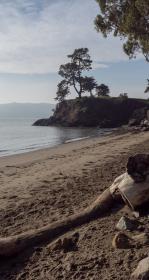
To Save the Bay, Save its Sediment
Sediment Meetings
Wed, Aug 19 2026, 9 - 11:30am
Bay RMP Sediment Workgroup Meeting
Wed, May 20 2026, 9am - 4:30pm
Bay RMP Sediment Workgroup Meeting
Thu, Mar 19 2026, 1 - 3:50pm
Bay RMP Sediment Workgroup Meeting
Tue, May 13 2025, 9am - 4pm
Bay RMP Sediment Workgroup Meeting
Wed, Mar 26 2025, 1 - 4pm
Bay RMP Sediment Workgroup Meeting
Thu, May 16 2024, 9am - 3pm
Sediment Workgroup (Day 2)
Recent Publications
Continuous Suspended Sediment Monitoring in South and Lower South San Francisco Bay Final Report
This report presents results from a three-year effort (2022-2024) to estimate continuous suspended sediment concentration (SSC) in the South Bay (SB) and Lower South Bay (LSB) regions of San Francisco Bay (SFB). We used…

Characterization of Sediment Contamination in San Francisco Bay Margin Areas: North Bay and Summary of the Dataset for the Whole Bay
San Francisco Bay margins (i.e., mudflats and adjacent shallow areas of the Bay that are shallower than 1 foot below mean lower low water [MLLW]) are important habitats with high potential for aquatic life to be exposed to…
Continuous Suspended Sediment Monitoring in South and Lower South San Francisco Bay Year Two (2023) Report
This report provides a project update for year two of a three-year collaboration between the San Francisco Bay Nutrient Management Strategy (NMS), San Francisco Bay Regional Monitoring Program, and South Bay Salt Pond…
ASSOCIATED STAFF