About the Sediment for Survival report
Maintaining healthy baylands that survive into the future under a changing climate requires us to redesign our landscapes as robust, resilient systems that take advantage of natural processes to derive desired benefits. Supplying baylands with adequate sediment is perhaps the most critical element for their survival. This project analyzes current data and climate projections to determine how much sediment may be available for tidal marshes and mudflats and how much sediment may be needed under different future scenarios. By combining these forecasts with scientific knowledge of natural physical and biological processes, we offer a strategy for sediment delivery that will allow these wetlands to survive a changing climate and provide benefits to people and nature for many decades to come.
Download Sediment for Survival
The resilience of San Francisco Bay shore habitats, such as tidal marshes and mudflats, is essential to all who live in the Bay Area. Tidal marshes and tidal flats (also known as mudflats) are key components of the shore habitats, collectively called baylands, which protect billions of dollars of bay-front housing and infrastructure (including neighborhoods, business parks, highways, sewage treatment plants, and landfills). They purify the Bay’s water, support endangered wildlife, nurture fisheries, and provide people access to nature within the urban environment. Bay Area residents showed their commitment to restoring these critical habitats when they voted for a property tax to pay for large-scale tidal marsh restoration. However, climate change poses a great threat, because there may not be enough natural sediment supply for tidal marshes and mudflats to gain elevation fast enough to keep pace with sea-level rise.
This report analyzes current data and climate projections to determine how much natural sediment may be available for tidal marshes and mudflats and how much supplemental sediment may be needed under different future scenarios. These sediment supply and demand estimates are combined with scientific knowledge of natural physical and biological processes to offer a strategy for sediment delivery that will allow these wetlands to survive a changing climate and provide benefits to people and nature for many decades to come. The approach developed in this report may also be useful beyond San Francisco Bay because shoreline protection, flood risk management, and looming sediment deficits are common issues facing coastal communities around the world.
Report authors: Scott Dusterhoff, Katie McKnight, Letitia Grenier, and Nate Kauffman (Strategic Adaptation Consultant)
Report design: Ruth Askevold, Katie McKnight, and Ellen Plane
Why study future sediment availability in San Francisco Bay?
The tidal marshes and tidal flats along the San Francisco Bay shoreline depend on sediment delivered by the tides. Healthy sediment supplies are essential for maintaining resilient marshes and tidal flats that can persist into the future and build up as sea level continues to rise. Currently, the sediment supply in the Bay is adequate to meet the sediment needed by tidal marshes and tidal flats. However, as sea level rise accelerates in the coming decades, the sediment needed for these habitats to survive will increase considerably. In addition, a healthy sediment supply will be needed to support the thousands of acres of restored tidal marsh that is being planned around the Bay. As sediment becomes an increasingly precious resource for habitat support and shoreline protection, it is essential to understand the future of sediment demand and develop an integrated strategy for long-term sediment management and monitoring.
Key takeaways from the report

- Tidal marshes and mudflats are unlikely to receive enough sediment naturally to survive sea-level rise this century. Restoring thousands of acres of historic marshes to the tides is invaluable for shoreline protection and the health of the Bay, but also increases overall sediment demand.
- Other local sediment sources offer the potential to help maintain tidal marshes and tidal flats that will be resilient as the climate continues to change. Preliminary analyses indicate that between now and 2100, sediment trapped in watersheds and dredged from the Bay, as well as soil excavated in construction projects around the region, will likely be greater than the amount of sediment arriving to the Bay from local rivers and the Delta.
- Management practices need to change quickly to access these other sources of sediment that can help increase the future resilience of tidal marshes and mudflats. Accessing these supplementary sediment sources will require rapid, unprecedented collaboration among public agencies, industry, and other stakeholders, as well as innovative approaches to sediment management and regulation. This report details a strategy for changing sediment management to increase the resilience of bay shore habitats and improve watershed health.
Project advisors and supporters
Sediment for Survival benefited substantially from the sound technical guidance, engagement, and enthusiasm contributed by the Technical Advisory Committee, Management Advisory Committee, and others that provided key project support.
Technical Advisory Committee
- Josh Collins (SFEI)
- Maureen Downing-Kunz (United States Geological Survey [USGS], now Environmental Science Associates [ESA])
- Lorraine Flint (USGS)
- Barry Hecht (Balance Hydrologics)
- Noah Knowles (USGS)
- Jeremy Lowe (SFEI)
- Lester McKee (SFEI)
- Michelle Orr (ESA)
- David Schoellhamer (USGS)
- Karen Thorne (USGS)
Management Advisory Committee
- Donna Ball (SFEI and South Bay Salt Pond Restoration Project [SBSPRP])
- Jessica Davenport (State Coastal Conservancy [SCC])
- Setenay Frucht (San Francisco Bay Regional Water Quality Control Board [SFBRWQCB])
- Brenda Goeden (San Francisco Bay Conservation and Development Commission [BCDC])
- Dave Halsing (SBSPRP)
- Roger Leventhal (Marin Dept of Public Works)
- Darcie Luce (SFEP)
- Brett Milligan (UC Davis)
- Heidi Nutters (SFEP)
- Sandra Scoggin (San Francisco Bay Joint Venture [SFBJV])
- Renee Spenst (Ducks Unlimited)
- Christina Toms (SFBRWQCB)
- Luisa Valiela (EPA)
Additional Support
- John Bourgeois (ESA, now Valley Water)
- Brenda Buxton (SCC)
- John Callaway (University of San Francisco)
- Susan De La Cruz (USGS)
- Naomi Feger (SFBRWQCB)
- Xavier Fernandez (SFBRWQCB)
- Amy Foxgrover (USGS)
- Matt Gerhart (SCC)
- Andy Gunther
- Bruce Jaffe (USGS)
- Michelle Stern (USGS)
The Science
Predicting the effects of climate change on bayland sediment demand and supply, and how these effects might in turn influence baylands resilience is complex and fraught with uncertainty. Depending on how and to what extent climate changes, bayland habitats could evolve in a number of ways. This study does not seek to determine what will happen with respect to future bayland sediment demand and sediment supply. Rather, it provides a range of bayland sediment demand and sediment supply estimates for different climatic conditions and bayland extents. The findings are based on the best available science and were developed with input and review by an interdisciplinary Technical Advisory Committee (TAC). The major assumptions, limitations, and uncertainties inherent to the analysis are presented in the Scenarios Analyzed section. For a full account of the methods, results, and discussion for each analysis described below, see Chapter 2 in the report.
Bayland Sediment Demand

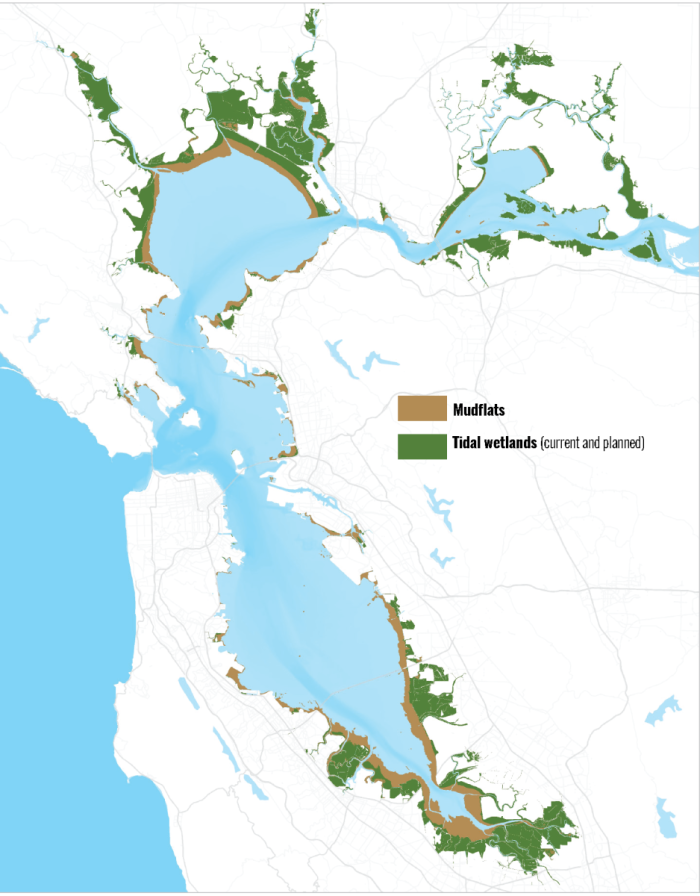
Bay wetlands and mudflats can grow vertically as sea level rises, which is what makes them so resilient. However, they need enough sediment (dirt carried by the tides) to do so. As sea level rises, the amount of sediment needed to maintain wetlands (current and restored) and mudflats at the right elevation will increase. This report used two baylands extent scenarios (i.e., alternative target extents for year 2100) within our sediment demand analysis to arrive at baylands sediment demand estimates between now and 2100. These baylands extent scenarios are based on the latest available regional mapping (i.e. Bay Area Aquatic Resources Inventory) for San Francisco Bay and consider the baylands habitats that currently exist as well as the additional areas of tidal marsh slated for restoration.
Approximately 364 Mt of sediment are needed for the 28,000 acres (~11,000 ha) of tidal flats and 51,000 acres (~21,000 ha) of tidal marshes of existing bayland habitats to keep pace with 2.1 m (6.9 ft) of SLR between 2010 and 2100. Bayland sediment demand would increase by approximately 50% to 548 Mt of sediment if the 24,000 acres (~10,000 ha) of planned tidal marsh restoration throughout San Francisco Bay are completed. It is important to note that the habitat scenarios chosen in this report do not include plans to restore tidal flats, so the total sediment needed for tidal flats to keep pace with SLR does not change between habitat scenarios. For more information on results, assumptions, and considerations, see pages 15-36 in the report.
Bay Sediment Supply

Estimates of future sediment supply to the Bay from the Delta were derived from modeled future Sacramento River sediment loads. As part of the USGS CASCaDE project, Stern et al. (2020) modeled annual total sediment load (suspended load and bedload) for Sacramento River at Freeport for WY2017–2100 for a suite of future climate scenarios including CESM1-BGC RCP 8.5 (the wetter future in this study) and HadGEM2-CC RCP 8.5 (the drier future in this study). An intensive analysis of future sediment supply to the study area for both climate scenarios was conducted for several focus Bay tributaries, and these results were then applied to all other tributaries to arrive at a comprehensive assessment of future tributary sediment supply. For each focus tributary, future annual sediment load to the Bay was determined for the wetter and drier futures at approximately head of tide, or the inland extent of mean higher high water, using a combination of historical sediment rating curves and modeled future runoff.
The compilation of the future supply of sediment to the Bay from the Delta and all 347 Bay tributaries for the full WY2010–2100 time period assessed for bayland demand shows the wetter future would result in 75% more sediment to the Bay than the drier future (280 Mt compared to 160 Mt). The Delta contribution to the total sediment supply is slightly higher in the drier future than the wetter future (44% compared to 36%).
Additionally, an assessment of the annual net flux between Bay subembayments and at the Golden Gate was compiled based on best available data. Annual net flux is essential for understanding the portion of the annual local sediment supply that remains within individual subembayments and could therefore be available for local bayland deposition, and the portion that is transported out of subembayments and could therefore be available for bayland deposition elsewhere in the study area. For more information on available flux data and other results, assumptions, and considerations, see pages 37-52 in the report.
Future Baylands Resilience
Vertical accretion of tidal marshes depends on many factors, including mineral sediment supply (Pestrong 1965, Krone 1987, Stralberg et al. 2011), organic matter accumulation (Patrick and DeLaune 1990, Callaway et al. 2012), inundation frequency (Duvall et al. 2019), vegetation dynamics (Pestrong 1965, Parker and Boyer 2017), soil compaction (Patrick and DeLaune 1990, Callaway et al. 2012), and land subsidence or uplift over time (Atwater 1977, Shirzaei and Burgmann 2018). With sufficient inorganic sediment and organic matter supply, shallow subtidal areas have naturally evolved into tidal marsh with vegetated plains at or slightly above local mean higher high water (MHHW), and can maintain these elevations for the range of SLR rates of the last two to three thousand years (Goals Project 1999, Byrne et al. 2001, Watson and Byrne 2009, Stralberg et al. 2011).
By combining the findings from the future bayland sediment demand and region-wide sediment supply analyses with a qualitative assessment of organic matter accumulation rates, we provide an indication of the baylands with the highest potential for long-term resilience with respect to vertical accretion for both a wetter or drier future. For more information on our assessment of bayland resilience and other assumptions and considerations, see pages 54-70 in the report.

Outreach
The findings of Sediment for Survival have been shared at regional meetings and conferences, with local and national news outlets, as well as across social media. More information can be found below.
Interviews
Presentations at conferences and meetings (2021)
- Bay Planning Coalition Annual Dredging Workshop
- Delta Plan Interagency Implementation Committee
- Long-term Management Strategy for Dredged Sediment (LTMS) Management Committee
- North Bay Watershed Association Board of Directors
- San Francisco Bay Conservation and Development Committee Commission
- San Francisco Bay-Delta Conference
- San Francisco Bay Restoration Authority Advisory Committee
- San Francisco Bay Restoration Authority Governing Board
- San Francisco Bay Regional Water Quality Control Board Governing Board
- San Francisco Estuary Partnership Estuary Blueprint Implementation Committee
Social media posts
NEW report release: "Sediment for Survival"
What is the future of bayland sediment demand and sediment supply under a changing climate? We provide a multi-benefit strategy for supporting bayland resilience.https://t.co/WFHLla1PeS#sedimentforsurvival#SFEIResilientLandscapes pic.twitter.com/c0g5hQCp9S— SFEI - ASC (@sfei_asc) April 13, 2021
SFEI's Letitia Grenier and Scott Dusterhoff will be on NPR! They were interviewed about #sedimentforsurvival. You can read about what they said in the story posted below or listen to their talk on Morning Edition this Sunday.#SFEIResilientLandscapeshttps://t.co/1t0oObpDdi pic.twitter.com/gAycaUB9WT
— SFEI - ASC (@sfei_asc) May 2, 2021
It's finally here! A short thread about @sfei_asc's new Sediment for Survival report: https://t.co/uBpEv6QV3v
— Christina Toms (@ChristinaToms) April 13, 2021
Scott Dusterhoff @sfei_asc on Sediment for Survival - A regional strategy to inform sediment management for resilience of tidal marshes and tidal flats to global warming #sealevelrisehttps://t.co/AqlxfPBEqc#SFBayRMP2021 pic.twitter.com/z6lTBnX3Jm
— Dr. Rebecca Sutton (@beckysuttonphd) October 14, 2021
Will we use forward-thinking nature-based solutions to protect our #SFBayArea shorelines from rising seas? SFEI details a regional strategy for resilience in their report, "Sediment for Survival". It has great fact sheets and infographics! 🌁🌊🌿😎#SedimentForSurvival @sfei_asc https://t.co/hYb41r4LFA
— Dr Denise ColomBOO👻no (@starryflo) April 13, 2021
Management Approaches
Managing sediment at the scales needed to take advantage of natural processes in watersheds, the Bay, and the Delta will require reworking of the approach to management and coordination currently in place. For example, sediment management currently is rarely coordinated between watersheds and baylands, the Delta and the Bay, or a locality that begins to scour when accretion happens in another place. A set of principles that helps guide thinking and planning can aid the transition to a new approach.
Employ principles of managing sediment for baylands resilience
Sediment for Survival outlines nine guiding principles (A to I) based on scientific investigations and community processes related to understanding the estuarine ecosystem and preparing for climate change impacts (e.g., Goals Project 2015, Milligan et al. 2016, SFEI and SPUR 2019). The list below distills the ideas from these other efforts to include only the aspects most relevant to sediment management.
(A) Complete tidal marsh systems are the goal.
(B) Geography matters; consider geography in planning.
(C) Expect change, plan for multiple future states.
(D) Take advantage of natural processes, which means managing sediment and water together.
(E) Don’t take for granted current access to sediment, freshwater, and tidal flows.
(F) Combine management approaches into strategies.
(G) Collaboratively implement strategies at the landscape scale.
(H) Coordinate at the regional and estuarine scales.
(I) Learn rapidly with a robust monitoring and adaptive management program.
To learn more, see pages 73-80 in the report.
Understand management opportunities
Within the region, waste products are being viewed more and more as valued resources for bayland restoration and shoreline adaptation, causing a shift in thinking around how to manage these resources to address bayland sediment deficits and accelerate bayland peat production. While some materials that would likely be disposed of—such as dredged sediment and excavated soils—are already being used in baylands restoration, additional opportunities exist to support bayland resilience. Resources that could be used to increase organic and inorganic accretion include (1) tidal and fluvial sediment dredged or mined from the Bay, stored in and removed from flood control channels, and trapped behind dams; (2) upland sediment in the form of excavated soils that currently end up in landfills, biosolids generated from wastewater treatment plants, and construction and demolition waste (e.g., brick, concrete, masonry, gravel, and stone) that could be used as a polder fill alternative in adaptation planning to preserve mineral sediment for more direct biotic uses; and (3) treated wastewater as irrigation in horizontal levees to support organic matter accumulation in marshes. Although biosolids, construction/demolition waste, and treated wastewater via horizontal levees are not permissible at present, these resource streams could be viable in the future as research evolves and sediment deficits increase. For each opportunity, we quantify the known relative magnitudes when available and provide other salient details.
To learn more, see pages 81-113 in the report. Refer to Appendix C for supplemental information used to calculate sediment mass for each source.

Create a place-based sediment management strategy
The sediment management measures (or actions) described above should rarely be implemented independently. Rather, to address sediment management objectives in watersheds and downstream baylands, measures focused on improving natural sediment processes and beneficially reusing sediment need to be combined to create sediment strategies (Figure 4.13). Strategies should be developed at the OLU scale through a collaborative process that includes a wide range of stakeholders, and should be adaptable over time as conditions change. They need to be built upon the best available science and site-specific information, with the measures included being selected based on an understanding of current and likely future conditions and through an examination of trade-offs. This section details the key steps at play when developing a place-based sediment strategy.
- Processes for creating a place-based sediment management strategy:
- Compile information for local sediment supply and bayland sediment demand and consider range of future climate outcomes
- Develop a long-term vision for sediment management in watersheds and adjacent baylands that identifies multi-benefit management measures
- Assess management options through landscape scenario planning
- Construct a local strategy to implement watershed and bayland sediment management measures over time
To learn more about each process listed above, see pages 114-117 in the report.

Fill critical knowledge gaps (research)
The results from this study and many others provide the science that can be used as the building blocks of sediment strategies that support bayland resilience. However, many knowledge gaps remain with respect to understanding potential future conditions under a changing climate and the factors controlling bayland sediment demand and supply at a range of spatial and temporal scales. Many researchers have recently put forth ideas about the knowledge gaps pertaining to Bay sediment science that need to be addressed to improve management approaches (e.g., BCDC 2016, SFEI-ASC 2017a, Schoellhamer et al. 2018). Sediment Survival offers a list of some of the most high-level critical knowledge gaps specifically related to the assessment of future bayland demand compared to sediment supply is provided.
To learn more, see pages 118-119 in the report.
Monitor to track bayland resilience
Monitoring the conditions of baylands will be essential to assess their ability to keep pace with SLR and the degree to which sediment management actions are supporting long-term resilience. This includes frequent measurements of local sediment processes and topographic change (e.g., annual net sediment flux to a marsh, annual net sediment deposition rates on a marsh, shoreline erosion/progradation rates) and key bayland resilience metrics based on monitoring data (e.g., tidal flooding depth and duration). Currently, bayland monitoring is typically done at the site scale as part of project compliance required by regulatory agencies or by academic institutions and research organizations seeking to understand local processes (e.g., Buffington et al. 2020, Lacy et al. 2020). However, there are new efforts focused on a coordinated regional approach to bayland monitoring that provide recommendations for monitoring actions, locations, and frequency based on previous monitoring approaches and an assessment of what is needed to track bayland resilience over time.
To learn more, see pages 120-124 in the report.






Other Individual Contributors

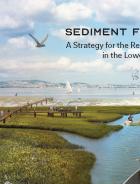
This report analyses current data and climate projections to determine how much natural sediment may be available for tidal marshes and mudflats and how much supplemental sediment may be needed under different future scenarios.

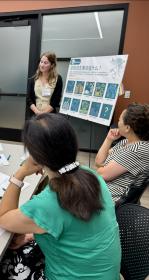
SFEI awarded over $7 million for Bay restoration and community partnerships
SFEI is the lead on three US Environmental Protection Agency Water Quality Improvement Fund grants totaling more than $7M.
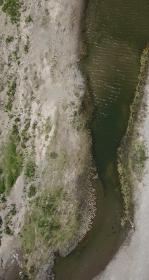
“Towards a Coarse Sediment Strategy for the Bay Area” completed!
The release of “Towards a Coarse Sediment Strategy for the Bay Area” represents a step forward towards beneficially reusing coarse flood control channel sediment by outlining reuse challenges, and identifying i
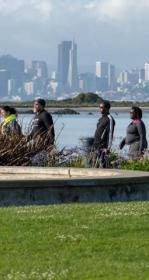
SFEI Developed the Bay Shoreline Flood Explorer for BCDC’s ART program, with More to Come
Over the past year, SFEI has been working with the Bay Conservation and Development Commission's (BCDC) Adapting to Rising Tides (ART) program to develop their new Bay Shoreline Flood Explorer.
Dashboards track cumulative benefits on the landscape
EcoAtlas dashboards are comprehensive views of qualified information provided by Project Tracker and the California Aquatic Resource Inventory (CARI). These dynamic visualizations help measure the cumulative benefits of public policies and programs for California's aquatic resources.