Models Inform Decision Making
Nutrient dynamics in San Francisco Bay are influenced by complex factors, including physical (like wind, waves, sediment), chemical (like nitrogen, phosphorus, carbon, oxygen), and biological (phytoplankton and microbes). The interplay between these physical and biogeochemical factors results in changes in the Bay’s nutrient levels.
The San Francisco Bay Nutrient Management Strategy (NMS) champions the development of a world-class hydrodynamic and water quality model. The NMS uses this model to shed light on the Bay's response to elevated nutrient levels and the repercussions of various scenarios, including nutrient discharge rates, sediment concentrations, and climate-driven temperature shifts.
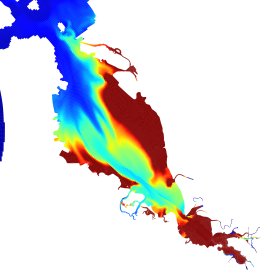
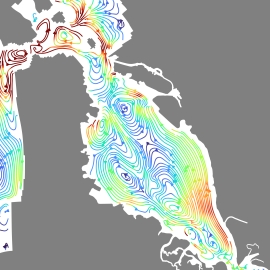
In 2014, the NMS began developing 3D hydrodynamic and biogeochemical models for the Bay using the Delft3D-Flexible Mesh suite. This marked the beginning of integrating advanced numerical modeling tools into nutrient management decisions. The effort explored nutrient cycling, source contributions, how nutrients leave the Bay, and the impacts of nutrient reductions on water quality, addressing critical environmental management questions with cutting-edge science.


Our early modeling focused on the Open Bay, the Suisun-Delta region, and the Lower South Bay. These tools enhanced our understanding of diverse Bay environments. The Open Bay model was developed with a basic set of processes and validated over a single water year, incorporating nutrient and organic matter cycling and primary production. We then added additional water years and more process complexity, incorporating grazing in the open water, sediment-water column nutrient exchanges, and a more sophisticated approach to specifying light extinction (how deep in the Bay light reaches). These refinements let us explore what drives nutrient cycling and the balance of ecological controls, laying a foundation for addressing nutrient management and environmental protection strategies in these critical habitats.
Beginning in 2020, the Open Bay model was extended to include six consecutive water years, enriching the nutrient cycling and primary production analysis. This period featured robust peer review by an advisory group, who provided expert feedback that led to further model refinements.
Key activities included detailed sensitivity analyses, exploring nutrient cycling and primary production drivers, and assessing how nutrients are transported from different sources within the Bay due to tides and freshwater inflows. The model also explored the 2022 harmful algal bloom and informed the nutrient load reductions required by the San Francisco Bay 2024 Nutrients Watershed Permit.

Informing Management Decisions
The Open Bay model was originally developed to assess how nutrient management strategies affect the long-term evolution of the water quality conditions within the Bay, not to address harmful algal blooms. After the 2022 harmful algal bloom and resulting fish kills, the model advisory group decided that the model could be used diagnostically to address questions about conditions favoring algal growth, evolution, and nutrient influence on bloom size, even if it was not developed for this purpose.
The NMS adapted the Open Bay model for this analysis by simulating different physical and biogeochemical features that may have favored an expansive bloom. We also assessed where dissolved oxygen would change from algae decaying after a bloom.
The model can help long-term nutrient management by evaluating risks of high nutrient levels on dissolved oxygen and primary production. Regulators are incorporating this information into decisions about nutrient management. Future efforts involve sensitivity analysis and scenario testing to refine how well the model assesses both long-term management and short-term strategies.

Featured Projects
ASSOCIATED STAFF