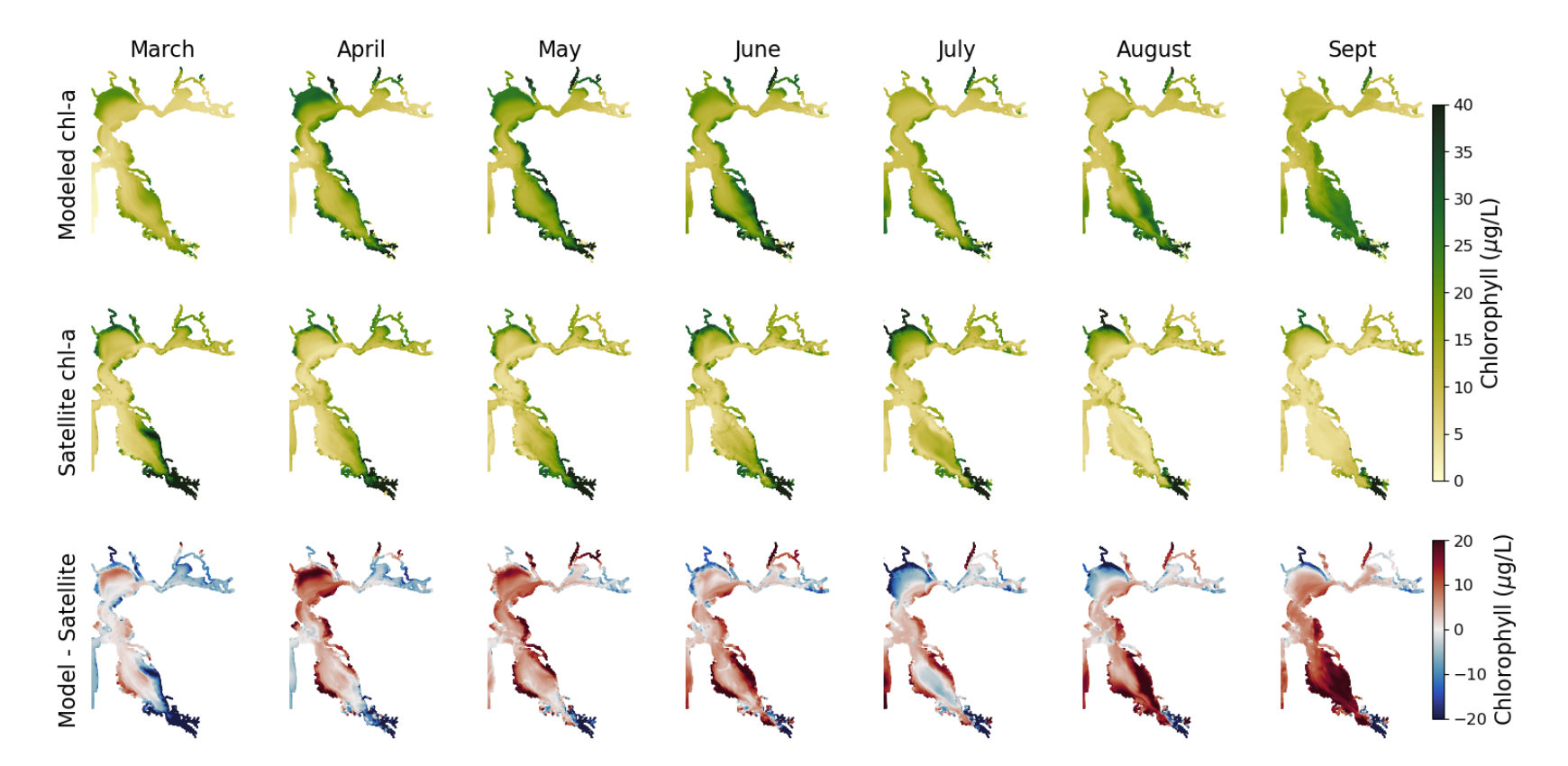
The Nutrient Management Strategy program doesn’t have a crystal ball for Bay water quality, but does have the next best thing: numerical models to simulate how physics, chemistry, and ecology connect to influence water quality in San Francisco Bay. These hydrodynamic and biogeochemical models are used to study nutrient cycling and the effects of nutrients on water quality. The new Open Bay Biogeochemical Modeling Progress Report summarizes the past three years of numerical model development and their increasing accuracy.
To date, the NMS has developed two separate models to predict conditions in the Bay. The hydrodynamic model can predict water level, velocity, salinity, and temperature. The biogeochemical model then uses the hydrodynamic model output and other information to predict nutrient levels, algae, dissolved oxygen, and more. Both models working together is essential to understand, and someday predict, when conditions could trigger harmful algal blooms in the Bay.
From 2023 to 2026, the NMS modeling team incorporated extensive improvements to both of the models. A group of external experts who advise model development for the NMS reviewed the improvements in August 2026. Their feedback will guide modeling priorities moving forward.