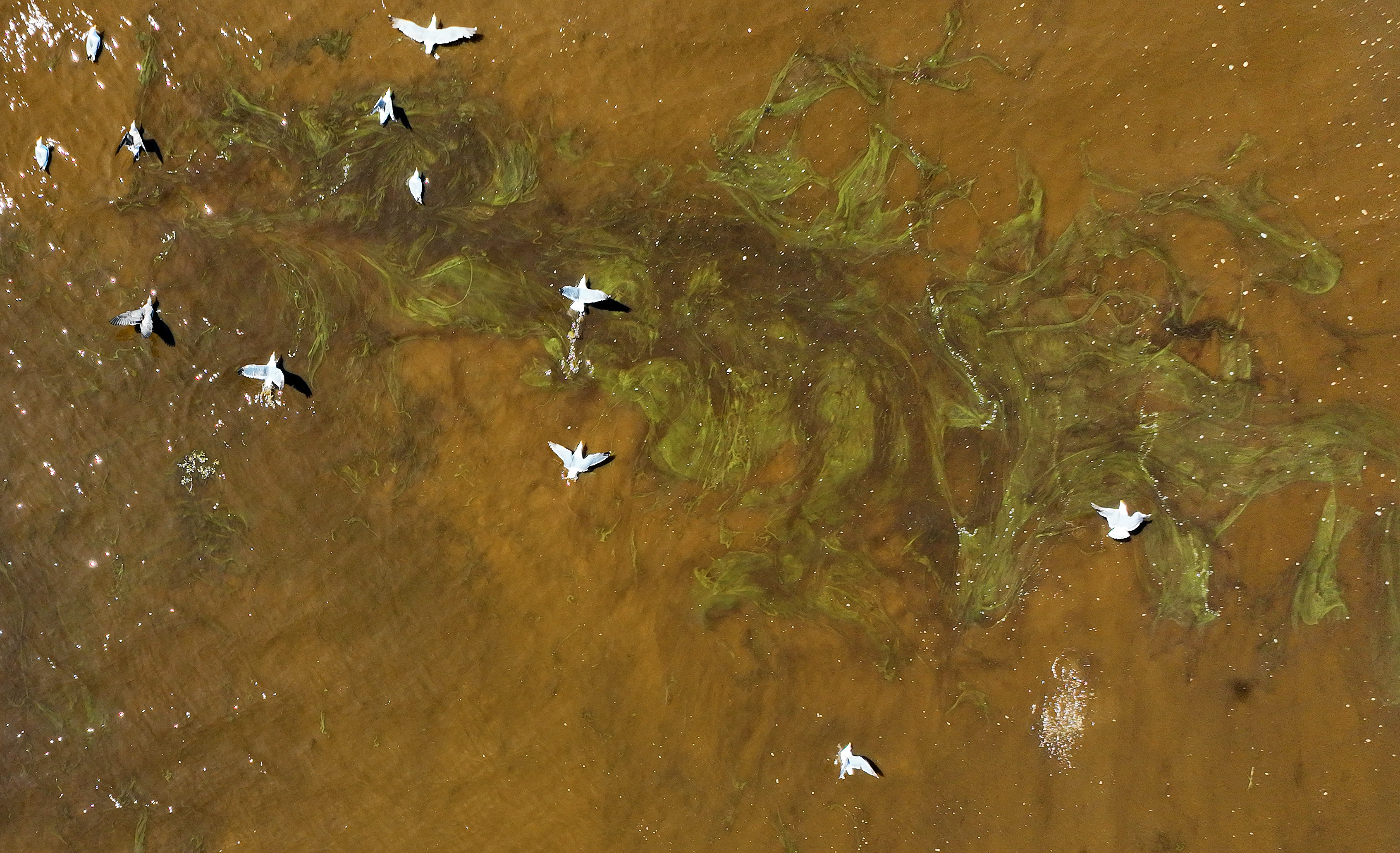
In July 2022, San Francisco Baykeeper received reports of rusty brown water in the channel between Alameda and Oakland. Staff like Baykeeper scientist Ian Wren, now with SFEI, soon became concerned as the messages from community members piled up.
“We often see discolored water in that area and around that time of year, but this was far more than usual,” recalls Wren.
Baykeeper alerted colleagues at SFEI, other regional water quality experts, and state officials, who diagnosed the problem as a fast-growing bloom of one algae species, called Heterosigma akashiwo (H. akashiwo). Within days, dead fish began lining the Bay shore by the dozens, then hundreds, then thousands. By mid-August, the brownish tinge of quintillions (millions of trillions) of individual algae cells stretched from the Dumbarton Bridge to San Pablo Bay.
Before 2022, scientists, wastewater agencies, and regulators shared growing apprehension over the potential for harmful algal blooms (HABs) in the Bay. Between the 1990s and 2010s, algae growth nearly tripled in some areas of the Bay. In 2002 and 2004, algae in the Bay reached levels that indicated potential HABs, but no fish mortality or water quality impairment was reported. Year after year, however, harmful blooms did not materialize.
Despite indicators that the Bay’s resistance to HABs had been decreasing, the 2022 bloom still took the region by surprise. The most impactful bloom in the Bay’s recent history, the 2022 HAB initiated a paradigm shift for regional managers, who went from asking, “Will it happen?” to “How do we make sure it doesn’t happen again?” In the years since, scientists in the region have investigated the factors that led to the bloom, how it progressed, and potential tools to protect the Bay in the future.
Read the full article in the 2026 Pulse of the Bay report, page 37. Request a free print edition of the report.



Harmful Algal Bloom identified in the San Francisco Bay
San Francisco Bay has been experiencing a major harmful algae bloom (HAB) event. Early signs of the developing bloom were reported in late July 2022 within the Oakland Estuary (between Alameda and Oakland).