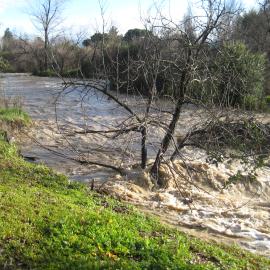
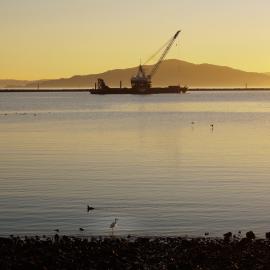
Historic and current regional management of watersheds and channels for water supply and flood control across the San Francisco Bay Area has cut off much of the coarse sediment that was historically delivered to the Bay. Here we define coarse sediment as having grain sizes larger than 0.0625 mm, which includes sand, gravel and even cobble, as opposed to fine sediment that includes
clay, mud and silt. Future projections indicate that sediment supply will not meet the demand from extant and restored tidal marshes to keep up with sea level rise.
The US EPA Water Quality Improvement Fund Preparing for the Storm grant has funded the Zone 7
Water Agency, the San Francisco Estuary Institute and the San Francisco Bay Joint Venture to support
the future development of a successful regional coarse sediment reuse strategy. Development of
such a strategy requires an understanding of logistical and regulatory hurdles and identification of key
strategies for breaking down barriers. One potential solution for meeting the sediment demand along
the Bay margin is to utilize coarse sediment that is removed from flood control channels by public
agencies. To-date, very little of this sediment that is removed is beneficially reused for restoration
along the Bay shoreline. The current economic and regulatory framework around sediment removal
presents many challenges, barriers and lack of incentives for agencies to reuse their sediment.
This document represents a step forward towards beneficially reusing coarse flood control channel
sediment by outlining reuse challenges, and identifying incentives for participation and potential
solutions.
| Attachment | Size |
|---|---|
| Medium resolution report copy | 6.11 MB |
| High resolution report copy | 11.71 MB |
Associated Projects