Engaging Oakland and Richmond to make a difference
Green Stormwater Infrastructure by and for Communities (GSI-C) is an SFEI collaboration with the San Francisco Estuary Partnership (SFEP), Urban Tilth, Hood Planning Group, and University of California, Berkeley (UCB).
The project asks the important question: how do we foster community-led urban greening that does not lead to gentrification?
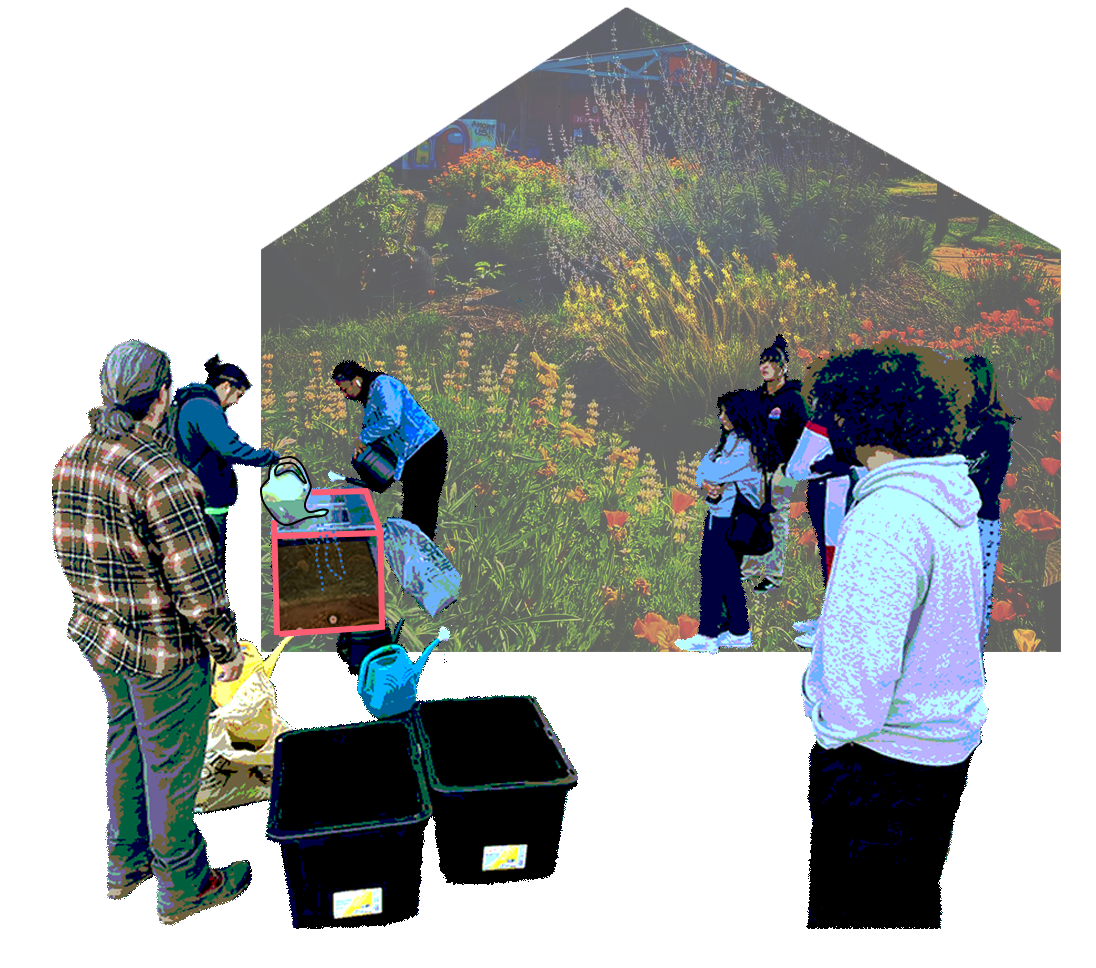
The project team begins with recognition for the community members' local expertise about their own environment and living conditions. Building upon that foundation, GSI-C augments their capacity to influence key decisions over urban greening and its effect on local water quality. Such capacity building has included technical knowledge, hands-on experience, and exploration of relationships between the engineering of green stormwater infrastructure (GSI), socioeconomic factors, and the limited resources of vulnerable communities in Oakland and Richmond, CA.
The project has created a curriculum to engage underserved communities in GSI design, invited them to engage with the project team in a community-driven GSI planning process, and built their capacity to contribute to future planning efforts. Communities have been invited to engage with planning and visualization tools (e.g., GreenPlan-IT, 3D modeling, and augmented reality), as well as groundwork and monitoring at local GSI installations.
The project aims to demonstrate an approach to siting, design, construction, and management of GSI that allows community participation to strengthen these processes. By incorporating direct community feedback into a neighborhood GSI plan, this approach provides benefits (e.g., connectedness to nature, community well-being and pride) beyond the water quality benefits of conventional GSI. The results of this collaborative effort will enhance existing green infrastructure along the Richmond Greenway, management of newly installed GSI in North Richmond and East Oakland, and implementation of new GSI by Skyline High School students in Oakland.











Other Individual Contributors


Great Strides for an Oakland Community: Green Stormwater Infrastructure
SFEI collaborated with community partners to generate components for a community plan for green stormwater infrastructure (GSI).