Innovative technology to identify new concerns
Nontarget analysis is a cutting-edge approach to uncover potentially concerning and unexpected contaminants. Unlike typical targeted analysis of known contaminants, this powerful tool provides an open-ended view of thousands of synthetic and naturally derived chemicals simultaneously. The San Francisco Bay Regional Monitoring Program (RMP) has explored Bay water quality with nontarget analysis for over two decades, making it a leader in using state-of-the-art science to inform decision-making.
Our analyses have identified hundreds of contaminants in Bay water and sediment. The results revealed that urban stormwater runoff is an important pathway for emerging contaminants to enter the Bay. We also applied this technique to samples of municipal wastewater discharged to the Bay, identifying a wide range of under-studied chemicals. Nontarget analysis has even revealed the impacts of wildfires on water quality.
These findings have informed follow-up targeted monitoring studies to quantify Bay concentrations of contaminants from products ranging from cosmetics to vehicle tires, and determine the risks posed to wildlife. Future RMP nontarget analysis will examine contaminants in samples of Bay fish and wildlife to expand on results from a 2015 screening of Bay harbor seals and mussels.










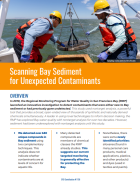
In 2018, the Regional Monitoring Program for Water Quality in San Francisco Bay (RMP) launched an innovative investigation to detect contaminants that were either new to Bay sediment or had previously gone undetected.
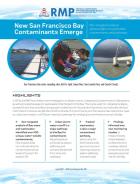
In 2016, the RMP launched a novel investigation to detect new or unexpected contaminants in Bay waters, as well as treated sewage (or wastewater) discharged to the Bay.

A comprehensive, non-targeted analysis of polar organic pollutants using high resolution/accurate mass (HR/AM) mass spectrometry approaches has been applied to water samples from San Francisco (SF) Bay, a major urban estuary on the western coast of the United States, to assess occurrence of emerg
Urban-wildland interfaces in the western US are increasingly threatened by the growing number and intensity of wildfires, potentially changing the type of contaminants released into the landscape as more urban structures are burned.
Wildfires can be extremely destructive to communities and ecosystems. However, the full scope of the ecological damage is often hard to assess, in part due to limited information on the types of chemicals introduced to affected landscapes and waterways.
The combustion of structures and household materials as well as firefighting during wildfires lead to releases of potentially hazardous chemicals directly into the landscape.
Bay RMP Non-Targeted Analysis Fact Sheet
In 2016, the RMP launched a novel investigation to detect new or unexpected contaminants in Bay waters, as well as treated sewage (or wastewater) discharged to the Bay.
Latest Estuary News takes a look “Beyond the Blubber”
Ariel Rubissow-Okamoto’s article “Beyond the Blubber,” based on interviews with SFEI Senior Scientist Rebecca Sutton and NIST Investigator John Kucklick, provides the scientists’ perspective on a just-completed RMP study that searched Bay biota for unknown contaminants.