A deep dive into historical archives is informing modern coastal restoration.
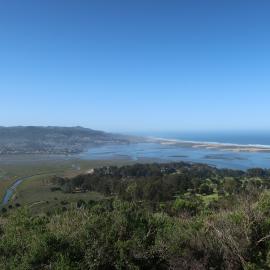
Morro Bay was historically a busy tableau of life under Indigenous stewardship. Sea otters played in the surf, steelhead swam in the streams, and grizzly bears abounded. In the Bay, broad expanses of shallow open water and tidal flats were bordered by tidal salt and brackish marshes. The water connected to open ocean through channels on either side of Morro Rock. Extensive sand dunes supported a mix of sparsely vegetated mobile dunes, coastal dune scrub, and maritime chaparral. In the surrounding river valleys, creeks were lined with riparian forests, willow groves, wet meadows, and freshwater marshes, while Tribes managed broad coastal prairies through cultural burning and other practices.
Today, communities seeking to revitalize Morro Bay face the question: how can we heal the landscape if we don’t understand how it functioned prior to European colonization and disruption?
Answering that question drove the research for the Morro Bay Historical Ecology Study, which SFEI conducted in partnership with the Morro Bay National Estuary Program. The study reconstructs landscape conditions in the Morro Bay Estuary and surrounding river valleys prior to major Euro-American modifications. By synthesizing a wide range of archival data sources, including over 100 maps, 140 texts, and 320 photos, the team mapped habitat types and channels as they appeared around the year 1850.

Post-colonial land use and channel modifications severely altered the landscape. Watershed erosion has decreased the amount of water in the Bay by 21% since 1884, contributing to eelgrass declines and other water quality and habitat impacts. Ranching, agriculture, and urban development have resulted in significant habitat loss and fragmentation throughout the watershed.

The historical ecology mapping and information developed through this study provide a critical foundation for setting actionable restoration targets and goals within the Morro Bay Estuary and its greater watershed. This historical lens is not meant to recreate historical conditions on the contemporary landscape, but to help identify restoration opportunities and prioritize projects that align with the location’s ecological potential and current land uses.
The Morro Bay Historical Ecology Study was funded by an EPA grant to the Morro Bay National Estuary Program.