
Highlights
- Tracking Bay Health is a multi-year USEPA grant that included an initial $6 million for the RMP
- This is a historic funding increase that is expanding monitoring, increasing special studies, supporting governance, and strengthening communication
- A total of $23.5 million has been requested that would provide a critical boost to the RMP, in particular by funding special studies on threats to Bay water quality
A New Era for the RMP
If the wind-teased Bay could eavesdrop on a brisk spring afternoon, it would have overheard Thomas Mumley, the Steering Committee Chair of the Regional Monitoring Program for Water Quality in San Francisco Bay (RMP), detailing the painstaking calculations made in recent decades to finesse the budget for special studies.
"[The RMP] has operated frugally for many years," he says, "and we can now revisit past decisions to cut back on and delay some program and work elements, and attend to the growing list of information needs.”
He's referring to the end of the days of scrimping for Bay water quality monitoring, which gave way to a new era for funding robust science at the start of 2025 with a $6 million grant to the RMP. It's the first installment of $23.5 million total for the RMP intended over five years from a US Environmental Protection Agency (USEPA) grant dubbed "Tracking Bay Health." The full grant also includes $15 million for the San Francisco Bay Nutrient Management Strategy over five years, bringing the total to $38.5 million. It’s an unprecedented investment in studying water quality in San Francisco Bay.
In recent years, the RMP’s budget couldn’t keep up with funding studies on the exploding list of newer concerns in the Bay, from microplastics to forever chemicals. The Program made calculated cutbacks to regular monitoring “to find ourselves more change in the couch cushions” for special studies without compromising the science, says Mumley.
But even with these adjustments, special studies to better understand emerging concerns were budgeted as frugally as possible. Others were postponed. That careful calculus wasn’t stopping the RMP from fulfilling its role, but “resulted in an ever-growing list of additional work to be done, which would likely compromise the integrity of the RMP in the future,” Mumley recalls.
The RMP has operated frugally for many years, and we can now revisit past decisions to cut back on and delay some program elements, and attend to the growing list of information needs
A Sea Change in Bay Funding
In late 2022, the federal San Francisco Bay Restoration Act established a new USEPA program office, and gave it a mandate to increase the funding to protect and restore San Francisco Bay.
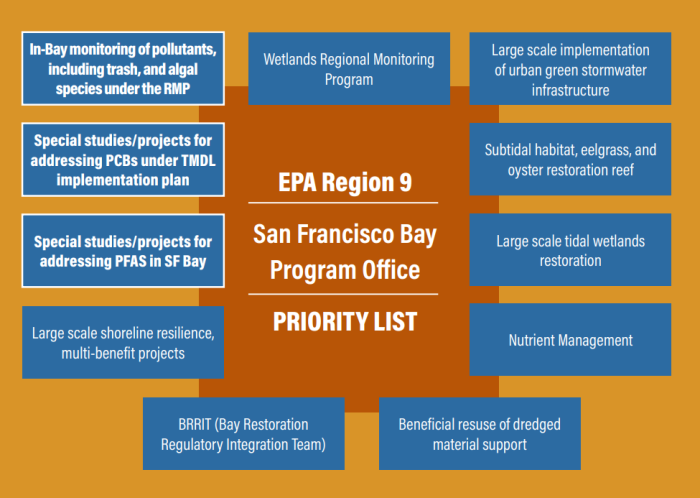
When the freshly minted San Francisco Bay Program Office released 11 priorities for the work it would fund (Figure 1), many could have been copied from an RMP wishlist. One even called out the RMP explicitly: “In-Bay Monitoring of Pollutants, including trash, and algal species under the Regional Monitoring Program.” Other priorities included special studies and projects on contaminants the RMP spearheads in the Bay, including PFAS (forever chemicals) and PCBs.
USEPA grants usually go through a rigorous competitive process to make sure only the best and most qualified organizations spend taxpayer money. But for Tracking Bay Health, the San Francisco Bay Program Office asked their grant managers to make an exception.
“Competing this grant would not result in a meaningful competition because EPA is not aware of any other organizations with the necessary expertise and regional support required to successfully complete the work that would apply,” the Regional Administrator wrote in the memo requesting an exception in summer 2024. The memo also asserted that the public benefits of fast tracking the funding would be substantial, including $6 million to the RMP immediately and more to follow through 2029. The first check arrived in January 2025.
Tracking Bay Health was born.
From Small Steps to Strides
Tracking Bay Health is already paying dividends for the RMP across every aspect of the Program.
“For a lot of years we were very budget constrained, so we were making really small steps in our progress,” says Bridgette DeShields, the Chair of the RMP’s Technical Review Committee. “By having that extra funding it'll allow us to advance at a faster rate—we can make strides in our management actions and trying to meet our long-term goals.”
One of those long-term goals is expanding the RMP’s focus on communicating the science behind its work, both to stakeholders and the broader public. Tracking Bay Health allowed the RMP to revive a quarterly email newsletter, refine a communication strategy for the first time in 11 years, and hire a professional science communicator for the first time in the Program’s 32 years.

“It's going to make more people aware of the RMP and the important work that we do,” says Amy Kleckner, the RMP Manager. “I think it's important for people who live in the Bay Area to know about the science that's going on in their own backyard.”
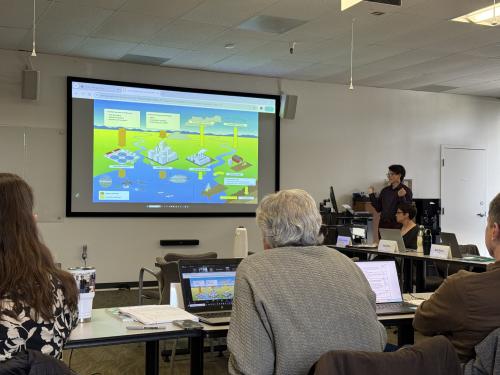
Some of the funds will also support the RMP’s careful balancing act of scientific rigor and collaborative decision-making that keeps the Program both grounded and nimble enough to adapt. Much of the recipe for the Program’s success depends on these ingredients—committee meetings, reviews by outside experts, and rounds of feedback—that all take time and resources. Karin North, the RMP Steering Committee Vice Chair and Assistant Director of Public Works for the City of Palo Alto, emphasizes the core importance of all these layers of input for “having people buy in and understand the critical decision-making points, how money is spent, the criteria, and how you rank different project proposals.”
Because of that governance structure, “[the committees] are well educated on what's going on, so they feel empowered to make decisions and change as well,” she continues. “It's the checks and balances…having a well-educated governance structure is critically important.”
Having a well-educated governance structure is critically important
And at the heart of the grant is additional money for the science itself. Those funds are expanding both routine monitoring work as well as special studies that would otherwise be shelved or conducted with bare-bones limitations. Kleckner points to one special study involving non-target analysis, a cutting-edge technique that allows scientists to scan Bay water for tens of thousands of chemicals at once. Budget constraints meant the original plan was to sample just five sites in the entire Bay. The Tracking Bay Health funds bumped that up to 22.
Kleckner sums it up with phrasing that several others involved in Tracking Bay Health would echo, almost verbatim, in describing the grant’s impact on the RMP: “We're going to be able to do more, and we're also going to be able to do better.”

From Ridgetops to Bayfloor
Many other studies are shovel-ready for prospective Tracking Bay Health funds to advance Clean Water Act priorities in San Francisco Bay.
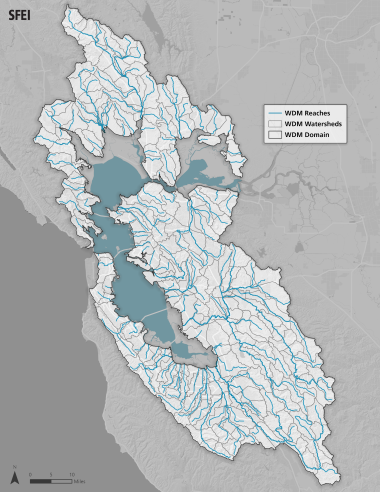
Because the Bay’s health starts upstream, one top priority is an additional $2.5 million to develop a complex full-watershed model including the 255 tributaries that all flow to the Bay. The improved watershed model will account for the many ways pollutants enter San Francisco Bay watersheds, including atmospheric deposition, old industrial sites, transportation, and from construction materials and consumer products, so it can accurately simulate how contaminants travel downstream to the Bay dissolved in water and attached to sediment particles.
“Our vision is to create an integrated suite of models that can be used to better understand water quality in the Bay—all the way from the ridgetops to the valleys, in the rivers and storm drains, and in the Bay itself,” says Matthew Héberger, the scientist leading RMP watershed modeling. “We would have the watershed model linked to a Bay model linked to a fish tissue model. Then we could ask how interventions at the watershed scale ultimately impact what we really care about, which is risk to humans and wildlife.”
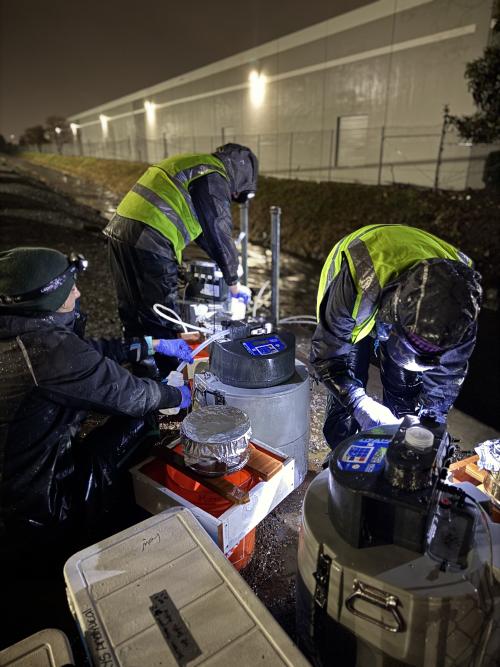
To get the hard data for making sure the watershed model matches the real world, the RMP relies on monitoring waterways during storms. For two decades, scientists in rain gear have rushed out at all hours as rainfall arrives to sample hundreds of sites over a wet season. But the data that give scientists the deepest understanding of how contaminants flow through the watershed over time come from sampling the same place continuously over several seasons. These data come from stations that stay planted in place within creeks and culverts to track contaminants and flows. The RMP hasn’t collected that type of extensive data from a single waterway since 2014.
“Now that we've had the hindsight of using the [fixed station monitoring] data that the team developed over the many years, we're now realizing how much we've really relied so extensively on that data,” says Alicia Gilbreath, the lead scientist for the watershed monitoring efforts.
Another $1 million from Tracking Bay Health funds would support reviving similar fixed-station watershed monitoring. Lester McKee, the architect of the earlier fixed-station effort, is the first to say how valuable fresh data will be.
“I knew that the data would have broader powers beyond what we ever imagined it would be used for. And we're still using it over and over again,” says McKee. He expects the prospect of new fixed-station data to be just as powerful, if not more, and points out that many high-priority contaminants like PFAS (“forever chemicals”) weren’t included in the older dataset.
For two decades, scientists in rain gear have rushed out at all hours as rainfall arrives to sample dozens of sites over a wet season
One way the monitoring data come to life is tracking PCBs, an industrial chemical notorious for sticking around in the Bay despite being outlawed a half-century ago. PCBs hitchhike into the Bay on grains of sediment that pour from creeks and culverts during storms, then settle around the Bay’s shallow edges. The Total Daily Maximum Load, a cleanup plan for PCBs in the Bay required by the Clean Water Act, hasn’t been updated for nearly two decades. To give regulators enough information to revamp that original action plan by 2030, RMP scientists are prioritizing making models that forecast how different management scenarios can influence PCB levels. Future Tracking Bay Health funds totaling $2 million would be key to produce thorough information for regulators on schedule.
Dozens of special studies on topics like forever chemicals and microplastics, that might otherwise be shaved down or shelved, would also proceed over the next four years with Tracking Bay Health funds. The rest of the money would continue to boost the same quiet but essential work that has been at the core of the RMP for more than three decades: ongoing monitoring of trends in the Bay and effective governance, which DeShields reminds “is critical to us having a world-class program and a program that makes a difference.”
Kleckner agrees. “These funds are also supporting our ability to coordinate more with our stakeholders, hold more meetings, have more discussions to better refine our studies,” she says. “These funds will support all of that important coordination and collaboration.”
A Healthier Bay
Jay Davis, the Lead Scientist for the RMP, sees the future of the Tracking Bay Health era as “the exciting challenge of growing the program.” But changes in EPA priorities have cast uncertainty on the upcoming allocations of Tracking Bay Health funding, a remaining total of $17.5 million for the RMP through 2029.
Kleckner hopes the merits of supporting the RMP’s work will prevail.
“This collaboration between scientists and stakeholders, to be able to do the science to inform management actions that could truly make a difference, I think is really unique,” she says. “Science for the sake of science is really cool, but it doesn't really get to the heart of, how can this science make our lives better, make the environment better, the Bay healthier?”
DeShields also emphasizes the non-partisan nature of the work achieved with Tracking Bay Health. “We have a wide set of stakeholders involved with the RMP,” she points out. “In our current environment a lot of things get very politicized. But we're focused on the science and what advances our knowledge of the Bay. We can provide [the policy makers] information, so they can make decisions about what the policies should be.”
Tracking Bay Health funds will make a difference for how quickly the RMP can give policymakers crucial water quality information—with more efficient public outcomes in the long run as a result
She adds that the continued support of Tracking Bay Health funds will make a difference for how quickly the RMP can give policymakers that crucial water quality information—with more efficient public outcomes in the long run as a result.
“By having that funding, it allows us to tackle new issues as they come up and be on the front edge of managing them,” she says, “instead of on the back end trying to clean them up later.”
As the Bay continues to recover from the 20th century, and faces new challenges, it will be more essential work than ever.
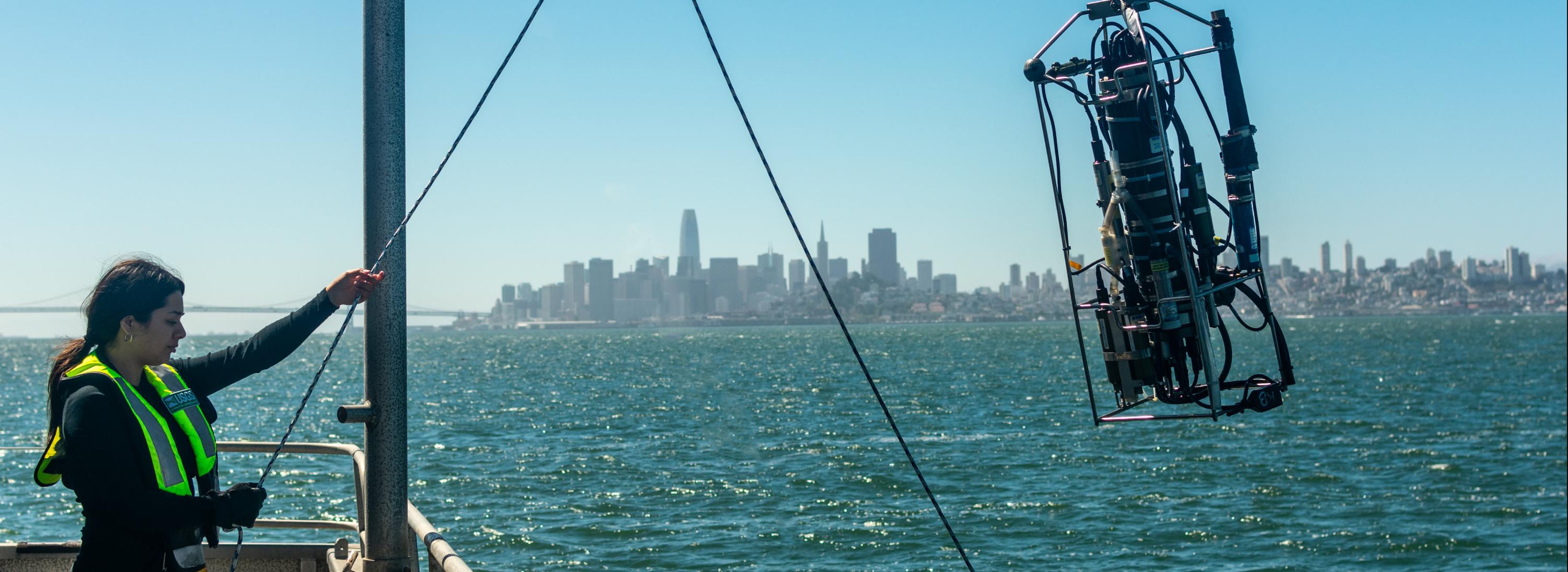
Top Photo: Deploying a sensor array in Central Bay on the 2024 water cruise. Photo by Alex Braud.

Out now: 2024 Pulse of the Bay
Contaminants of emerging concern (CECs) take center stage in the 2024 Pulse of the Bay, the signature publication of the Regional Monitoring Program for Water Quality in San Francisco Bay (RMP).
The overarching goal of the Regional Monitoring Program for Water Quality in San Francisco Bay (RMP) is to answer the highest priority scientific questions faced by managers of Bay water quality.