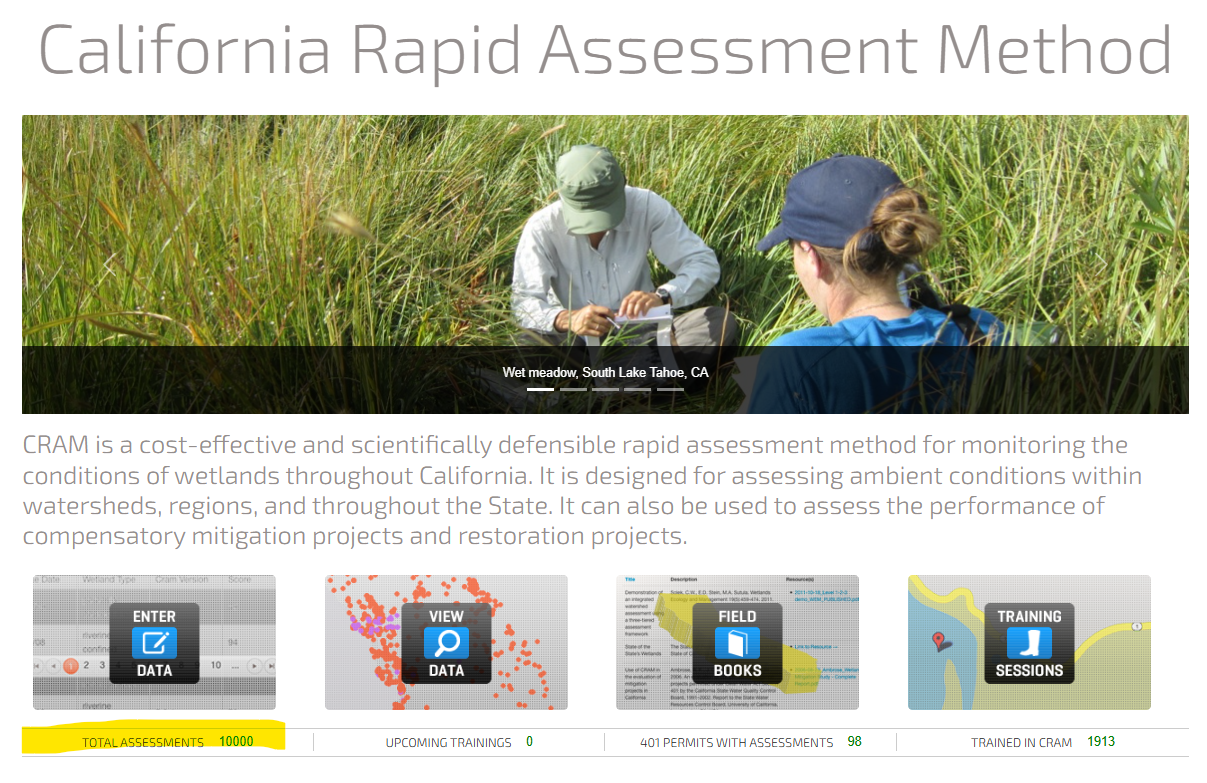
A milestone for tracking wetland protection and restoration.
On November 11, 2025 we reached an exciting milestone: 10,000 wetland condition assessments are now publicly available on EcoAtlas. This statewide visualization and mapping tool expands public access to environmental information, supporting wetland protection, restoration planning, and project performance tracking. EcoAtlas advances a watershed (or landscape-based) approach championed by the California Wetland Monitoring Workgroup of the state’s Water Quality Monitoring Council.
The California Rapid Assessment Method (CRAM) is a field-based observational method for assessing the overall ecological condition of streams and wetlands. CRAM assessments are easily accessible though EcoAtlas, making it an important resource for monitoring that can compare restoration projects to each other or to expected reference conditions. CRAM assessments can also track project performance. For example, when a wetland project’s overall Index Score is unexpectedly low, managers can drill down into the component metrics to gain insights into specific adaptive management actions that could improve the project’s ecological condition.
Zooey Diggory, a senior biologist at Valley Water says, “As the foundation of our county-wide watershed monitoring program, CRAM is effectively and efficiently providing context for our work and regulatory assessments, as well as specifics for stream enhancement designs AND effectiveness monitoring.”
EcoAtlas also hosts a number of CRAM tools that help resource managers evaluate the ecological condition of restoration and/or mitigation projects using a watershed or regional approach to project planning and performance tracking. Those tools include watershed and ecoregional stream and wetland condition profiles (or Landscape Condition Profiles) that can help place the condition of a project within its broader watershed context, and habitat development curves that compare a project’s condition to the expected rate of natural wetland development.
“I like the streamlined approach of CRAM,” says Carey Kowalski with the San Diego Regional Water Quality Control Board. “With multiple attributes and stressor identifications, [we can] quickly determine a wetland’s condition and how to best improve it.”
For more information please see https://www.ecoatlas.org/about/ and explore the interactive map and profile tools.










California Rapid Assessment Method for Wetlands (CRAM) Updates
CRAM Training sessions for 2020 have been posted on the CRAM website.
Web Services Available for CRAM and Wetland Projects
Web services provide a standard way to access geo-referenced data online.
Meredith Williams discusses the primary benefits of EcoAtlas to the state's body of knowledge about its wetlands. How does EcoAtlas advance our collective understanding about wetland condition? What restoration projects are underway and where are they taking place?