
Hundreds of bottles of Bay water. Thousands of chemicals. Five dawn-to-dusk days all over San Francisco Bay.
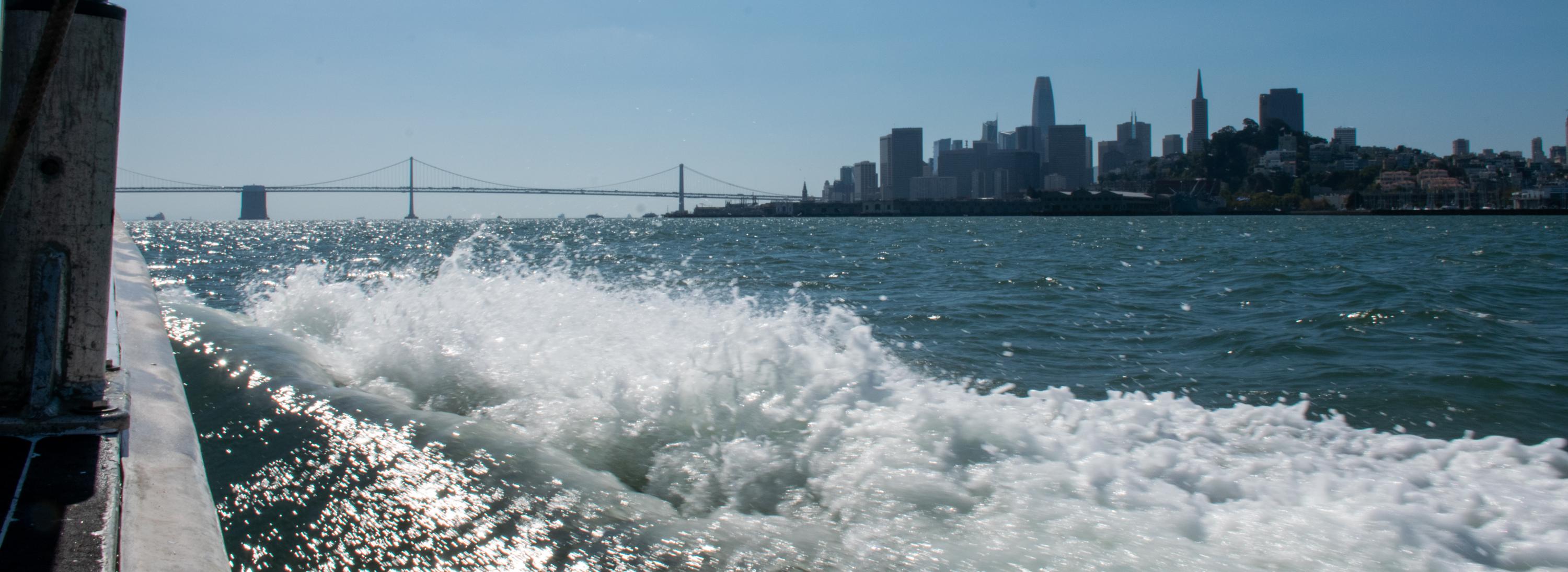
Every two years, the Regional Monitoring Program embarks on a mission to sample water from the surface of the Bay for water quality measurements and pollutants, both known and yet to be identified. This year, we visited 21 sites across every part of the Bay, plus one site a few miles outside the Golden Gate.
Anchors Away
Each day begins just after dawn with a half dozen scientists loading up the RV Questuary with coolers, dry ice and regular ice, sampling gear, and more than a hundred labeled sampling bottles. The entire boat could fit inside a big rig, and closed coolers often double as seats on the tightly-packed deck.
The boat glides to a stop on a glassy, grey Bay. It’s a relief for those who recall the 2023 sampling, which featured vomit-inducing swell and a broken motor setting the boat adrift beyond the Golden Gate bridge.
Once the captain gives the word, everyone claims a corner of the vessel to bring pieces of the Bay onboard. The port aft (left back) deck becomes a station where clear, flexible tubing connects to a machine that pumps up a thin stream of water. To the starboard (right), a scientist hoists a long pole with a metal pitcher fitted on the end high over the water. The contraption splashes down, the pitcher is hauled in, and the water collected is poured into a sampling bottle. The same scientist repeats it again, and again, sometimes heaving out the pole several times in a row to give the pitcher a good rinse. At least it’s arm day, she jokes.
The Rigors of Research
Collecting high-quality water samples isn’t easy. Staff can’t use their regular hand sanitizers or sunscreens for fear of contaminating samples with extra helpings of the very chemicals we’re testing for, like antimicrobial ingredients or PFAS (forever chemicals). We’re picky about clothes; nothing waterproof or insecticide-treated, since they can also shed the very chemicals we analyze in the water samples. Nobody can flush the onboard toilet near the sampling sites.
We also bring clean water to pour into identical bottles at the same moment the samples are collected. Analyzing their contents along with the samples makes sure the results come from the Bay, and not inadvertent contamination from the process of scooping up and bottling the water. The bottles themselves are sterile inside, often thanks to a treatment of immense heat and pressure that rid them of any traces of the chemicals we’re testing for. Each type of sample needs to go in a bottle made from different materials, colors, and sizes.
What's In The Bay?
After sampling every part of the Bay, the team has piped water into 790 bottles that range in size from gallon jugs to vials smaller than a smartphone. Together, they contain enough water to fill a car’s gas tank 14 times. The samples are tucked into coolers under ice, and couriered across state and national borders for analysis at one of seven labs, plus two others for special studies. They’ll assess heavy metals, plastic additives, cleaning product ingredients, flame retardants, and more.
Eventually, the story these results reveal will help shape the future of San Francisco Bay. The data may show that the Bay is recovering from banned pollutants, or reveal new concerns. We may notice patterns within the Bay that give clues about sources of contamination, or how the Bay works—we already expect the South Bay to have higher levels of many contaminants in part because water lingers there longer instead of flushing out to sea. Whatever we find, the data will be available for anybody to explore, and lead the way for future decision making.
The biennial water cruise is part of the Status & Trends monitoring program directed and funded by the Regional Monitoring Program for Water Quality in San Francisco Bay, with operational support from Applied Marine Sciences Inc. In 2025, it was also funded by the San Francisco Bay Office of the US Environmental Protection Agency and supported by Cal Poly Maritime Academy through use of the R/V Questuary.