
SFEI recently completed the Suisun Landscapes project, a multi-million, multi-year effort funded by Delta Stewardship Council and the US Bureau of Reclamation.
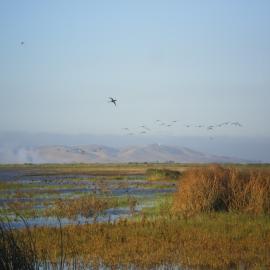
Suisun Marsh is one of the largest brackish tidal marshes on the West Coast of North America and provides habitat for rare and endangered species. While much of the marsh's historic habitat and wildlife have been lost, Suisun is still a hotspot for biodiversity and a destination for hunters, fishers, and boaters who use its managed wetlands. Because it is just downstream from the source of the State and Federal Water Projects, the marsh’s health affects the state’s water supply and decisions about water infrastructure in the Delta.
As part of the project, the SFEI team delivered a report for managers and a modeling tool that will help planners evaluate the impact of restoration projects at a landscape scale.
A Marsh Transformed: Historical Ecology and Landscape Change in Suisun Marsh is a report for managers to inform landscape-scale, collaborative adaptation planning in the Suisun Marsh. Using historical documents such as archival maps, photographs, and narrative accounts, SFEI pieced together a complete picture of landscape conditions in Suisun Marsh in the early 1800s, before European-American colonizers began to transform the land.
A Marsh Transformed provides the historical and present-day context that can form the foundation of science-based conservation goals for Suisun. SFEI has undertaken similar efforts in San Francisco Bay and the Delta that led to collaborative regional goals for those ecosystems. SFEI’s aim is for the next stage of work in Suisun to use the content of A Marsh Transformed to run a collaborative process with resource managers, landowners, marsh visitors, and Tribes to crystallize goals for Suisun.
As a companion to A Marsh Transformed, the team updated and expanded the Landscape Scenario Planning Tool (LSPT) to answer landscape-scale management questions for Suisun. The LSPT is an open-source GIS tool for planners and researchers in Suisun and the Delta. The LSPT enables planners and researchers to compare historical, contemporary, and alternative scenarios for future landscapes to evaluate how land use decisions would impact wetland habitat, carbon sequestration, agriculture, and other ecosystem services. The latest version (LSPT 3.0) includes updated analyses and data for Suisun Marsh, plus a new module to understand marsh migration space.
The transformation of the Suisun Marsh over the past two and a half centuries offers valuable insights for its future management and preservation. As the region navigates the uncertainties of a changing climate, collaboration grounded in understanding the marsh’s history is crucial for charting a resilient future.


Introducing the Landscape Scenario Planning Tool Version 2.0
In partnership with the Delta Stewardship Council, the San Francisco Estuary Institute has developed version 2.0 of the Landscape Scenario Planning Tool, a GIS-based analysis toolkit to evaluate user-designed land use and restoration scenarios for the Sacramento-San Joaquin Delta and Suisun Marsh