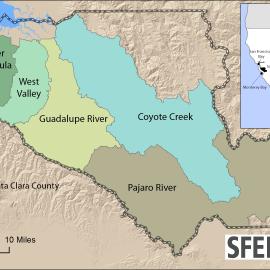
The Santa Clara Valley Water District’s (Valley Water) Upper Llagas Creek Flood Protection Project (Project) aims to increase flood protection within the City of Morgan Hill and surrounding unincorporated areas. Project impacts are being mitigated by permittee-responsible onsite, in-kind stream, wetland, and riparian creation and restoration in select locations at Lake Silveira. The Mitigation and Monitoring Plan (MMP) guides the required monitoring of the project. The primary objective of the MMP is to ensure that there will be no net loss of wetland or riparian function and values resulting from either direct, indirect and/or cumulative impacts associated with construction of the Project.
Monitoring that characterizes and tracks changes in the overall ecological health (or condition) of streams and wetlands at the site is being conducted using the California Rapid Assessment Method (CRAM). The San Francisco Estuary Institute (SFEI) conducted the baseline, pre-project CRAM assessments in 2015, and the Year 5 CRAM assessments in 2025. CRAM is being utilized as an overall check of a number of standardized stream and wetland condition metrics to determine if the mitigation at Lake Silveira is on-target compared to pre-project conditions, its watershed context, and expected rates of maturation of wetland projects in general, or if adjustments are necessary within the project as a whole.
CRAM has contributed to the collective understanding of the success of the project and to help evaluate if adjustments might be warranted to improve conditions within the project. The CRAM assessments have demonstrated:
- The 2025 CRAM Overall Index Scores for the mitigation site are all in Fair to Good condition, and the restoration actions have maintained or improved the condition of the
streams and wetlands in the mitigation site since 2015; - Significant and meaningful lift in condition has occurred in some portions of the mitigation site;
- Other portions of the mitigation site show small declines in condition at the Overall Index Score level, however these changes in score are within the precision of the method and are not statistically significant;
- Only five years have passed since construction was completed. Streams and wetlands often require more time to mature, increase in complexity, and improve in condition. Continued improvements in the overall ecological conditions across the site are expected into the future.
- CRAM guides potential adaptive management actions that could be taken to increase stream and wetland condition on site, however, it is likely that continued improvement will occur without intervention, given more time.
Including CRAM within the Year 5 monitoring required by the MMP has provided value to the project in ways that other monitoring methods cannot. CRAM is a standardized and scientifically defensible tool that provides quantification of overall ecological condition, and can be used to track mitigation project performance, and provide a common understanding of progress to project proponents, regulatory staff, and the public. As was completed for Lake Silveira, CRAM can also be utilized to predict future condition of a stream or wetland, to help inform and guide management decisions and define expectations.
| Attachment | Size |
|---|---|
| Lake Silveira CRAM Mitigation Monitoring Report Year 5 | 2.71 MB |