A more resilient Valley
Resilient Silicon Valley is a project of the San Francisco Estuary Institute to build the science-based framework needed to guide the design of and investments in regional ecosystem health.
Drawing on resilience science, regional data, and local expertise, we are developing the vision and tools that will allow stakeholders in the region to ensure that local actions contribute toward the creation of a high-functioning and resilient Silicon Valley ecosystem. The Resilient Silicon Valley project harnesses SFEI’s extensive regional expertise, data, and partnerships needed to guide investments in regional ecosystem health.
In collaboration with Google’s Ecology Program, SFEI has created the Landscape Resilience Framework; a practical guide that identifies the core elements needed for building ecological resilience across landscapes. Building on this foundation, two projects are applying the framework in the region. In A Vision for a Resilient Silicon Valley, SFEI and a team of regional science advisors develop a vision for landscape resilience across streams, hills, baylands, and urban areas of Silicon Valley. In Re-Oaking Silicon Valley, we explore how re-incorporating elements of oak woodland ecosystems into cities could enhance biodiversity, benefit people, and contribute to regional resilience. The visions developed through these projects will provide a strategic basis to inform local design and planning efforts and allocate resources that support a holistic vision of healthy ecosystems. We hope these projects will ultimately provide shared guidance across Silicon Valley for those looking to contribute to regional resilience.
About the Project
The Resilient Silicon Valley project draws upon SFEI’s extensive regional expertise, data, and partnerships to lay the scientific groundwork needed to guide investments in regional ecosystem health. In the first phase of the project, SFEI is collaborating with Google’s new Ecology Program to apply the framework in support of adaptation and restoration strategies with real benefits for the Silicon Valley. The vision developed through the project will provide a strategic basis to inform local design and planning efforts and allocate resources that support a holistic vision of healthy ecosystems. We hope it will ultimately become a shared guide across Silicon Valley for those looking to contribute to regional resilience.
The Resilient Silicon Valley project has three main components:
Landscape Resilience Framework

How can we sustain biodiverse, healthy ecosystems and landscapes, from cities to wildlands? And how can we design these landscapes to be more resilient to the rapid environmental changes that are anticipated over the coming century – that is, to be robust and flexible enough that they are able to persist and evolve over the long run?
We have developed a Landscape Resilience Framework to help translate resilience science into a set of practical considerations for landscape management. The goal of the Framework is to facilitate the integration of resilience science into a wide variety of efforts, from urban design and green infrastructure to conservation planning and ecological restoration.
 Report for a general audience
 Peer-reviewed journal article
 Applications of the Framework
Applying the Framework
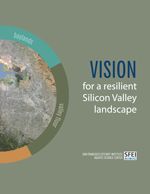
A Vision for Landscape Resilience |
|
|
We worked with a team of regional science advisors to develop a vision for landscape resilience across the streams, hills, baylands, and urban areas of Silicon Valley. To do this, we are applying our Landscape Resilience Framework to identify landscape elements that would contribute to resilience in the region. Ultimately, we hope this vision will provide a shared foundation, aligned with other regional planning efforts, to catalyze discussions among scientists, planners, managers, designers, and others about specific actions that could improve landscape resilience. |
Re-Oaking Silicon Valley |
|
|
In Silicon Valley, oak ecosystems were the defining feature of the landscape before large-scale transformation. Oak savannas and woodlands were so extensive that the valley was christened the Llano de los Robles, or Plain of the Oaks, by early explorers. In little more than a century, Silicon Valley’s oak woodlands were felled, replaced with orchards, and then replaced again with a patchwork of urban trees. The rapid and continuing transformation of Silicon Valley creates an unusual opportunity to recover some of the region’s natural heritage by re-incorporating elements of oak woodland ecosystems. These changes could contribute to building landscape resilience in the region, increase biodiversity, and benefit people. Much of Silicon Valley's urban forest, planted 50-75 years ago, is nearing the end of its lifespan. Over the next few decades, local communities will create the next urban forest, shaping the sense of place, human health, and biodiversity of Silicon Valley for the rest of the 21st century. Given the challenges of drought and climate change, do Silicon Valley's native oaks – largely gone for a century – have a greater role to play in the coming century? Our report, Re-Oaking Silicon Valley, begins to explore that question, focusing first on the benefits the re-oaking could have for local biodiversity and native wildlife. Learn more about SFEI's broader re-oaking project. |
Demonstration Projects
Google's Resilient Silicon Valley Awards Program has two primary goals:
- To align Google's support of local environmental health with the science and vision of the Resilient Silicon Valley Framework.
- To deliver consistent, meaningful support to the local community, linking our ecological efforts with those of the broader community.
In 2016, nine Awards were made to local environmental organizations in Silicon Valley in four different categories: Education, Demonstration, Research & Assessment and Native Plant Restoration. Google is also investing in projects on campus to restore native habitat for both people and wildlife in line with the Resilient Silicon Valley Vision.
- Audubon: Bird Conservation Mapping & Education
SCVAS provides education and bird conservation awareness that focuses on the health of riparian corridors, designated mitigation areas, historical breeding locations and suitable habitat areas. - Community Advocates Leadership Academy Program
Decisionmakers pay attention when they hear from people in the communities they serve, yet effective citizen engagement, especially in land use planning, is a challenge for even the most... - Google Campus -- Charleston Retention Basin
- Google Campus -- Green Loop
- Google Campus -- Native Nursery Facility
- Native Plant Resources for Santa Clara Valley Residents
The mission of the California Native Plant Society is to conserve California native plants and their natural habitats and increase horticultural use of native plants. - Phytophthera Detection Dog Pilot Study
Pilot study to test the efficacy of using ecological scent-detection dogs to survey for phytophthora, a disease initiator that interrupts the healthy biological processes that are required for... - Re-Oaking Palo Alto
Regionally, the decline in deciduous oak species and oak woodlands has become a major conservation concern for the City of Palo Alto. - Resilient Silicon Valley Public Outreach
The San Francisco Estuary Institute has developed the Resilient Silicon Valley Vision over the past two years, with support from Google. - San Francisco Bay Trail Audio Walking Tour
The SF Bay Trail connects communities to parks, open spaces, schools, transit and to each other, and also provides a great active transportation corridor. - School Native Habitat Garden Citizen Science Program
Living Classroom provides ecology lessons in 21 native habitat gardens in Mountain View, Los Altos and Palo Alto 1-8th grade classrooms. - Silicon Valley Water Stewardship Project
Residents of Silicon Valley are fortunate to have an abundance of parks and open spaces that provide us with a range of recreational, aesthetic, and cultural benefits and ecological functions.
More Information
The San Francisco Estuary Institute is an environmental science non-profit that uses cutting-edge science research to develop visions for adaptive, resilient ecosystems across California. For more information on SFEI or the Resilient Silicon Valley project, contact the Urban Nature Lab ([email protected]).
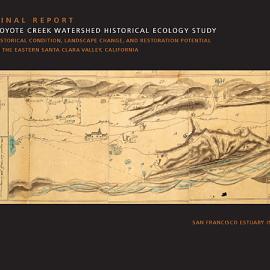
SFEI also has a number of past and ongoing studies relevant to the Resilient Silicon Valley project. These include historical reconstructions of Western Santa Clara Valley, Southern Santa Clara Valley, and the Coyote Creek Watershed, as well as studies exploring landscape resilience for the Sacramento-San Joaquin Delta and Bay Area creeks.
Resilient Silicon Valley is funded by charitable contributions from Google's Ecology Program. The mission of Google's Ecology Program is to collaborate with scientists, designers and community members to design vibrant living systems in the communities Google calls home. For more information, contact Ecology Program Manager, Erin Beller ([email protected]).






In this report, we investigate how re-integrating components of oak woodlands into developed landscapes — “re-oaking” — can provide an array of valuable functions for both wildlife and people.
Urban Ecological Planning Guide for Santa Clara Valley published
SFEI partnered with the Santa Clara Valley Open Space Authority to create a guide for how to support biodiversity across the urbanized landscape of Santa Clara Valley.
SFEI and Google share Award for Re-Oaking
SFEI and Google have won the Arnold Soforenko Award from the non-profit Canopy for significant contributions to the urban forest.
SFEI partner Canopy plants oaks in East Palo Alto
On Martin Luther King day, 170 volunteers came out to help plant oaks and other native landscaping at the St. Francis Assisi church in East Palo Alto.
Disrupt the Street Tree: Could trees help Silicon Valley find an identity?
As recently as a 1850, according to a recent report from the San Francisco Estuary Institute, 80 percent of the trees in Palo Alto, Mountain View and Cupertino were oak trees. Another 13 percent of the trees were those commonly found alongside oak trees in oak woodlands: buckeye, madrone, sycamore, and California bay laurel. Willows, alders, and redwoods rounded out the final 7 percent. Oaks created the place. Postcards from San Jose in the early 1900s show farmers standing in the shade of skyscraping oak trees. Spanish explorers called Silicon Valley the “plain of the oaks.” The Peninsula is still home to two Roblar Avenues, a Robles Drive, and a Robles Park, as well as the North Fair Oaks and Menlo Oaks neighborhoods of Menlo Park.
Science Support for Resilient By Design Competition
The challenges of accelerating sea level rise and aging shoreline infrastructure are creating a once-in-a-century opportunity to redesign the Bay shore.

Announcing the release of Re-Oaking Silicon Valley: Building Vibrant Cities with Nature
Could restoring lost ecosystems to cities play a role in building ecological resilience across landscapes? In Re-oaking Silicon Valley, a new report by SFEI, we explore this opportunity in our region.
Our partnership with Google to enhance the ecological resilience of urban landscapes is featured in a story by Fast Company, a Google Blog post, and an accompanying video.
SFEI scientists present at national Living Future conference
In April 2015, Robin Grossinger and Erin Beller traveled to Seattle to present at Living Future, a national conference focused on green building, landscaping, and design. Robin and Erin co-presented with Audrey Davenport, Google's Ecology Program lead.